


The Anatomical Revolution
How cutting open bodies rewrote medicine.
Illustrations
Browse all500 images extracted
This famous woodcut portrait depicts Andreas Vesalius at age 28, the author of the groundbreaking anatomical text 'De Humani Corporis Fabrica'. Unusually for the period, he is shown not just as a scholar but as an active dissector, grasping the muscles of a human arm to demonstrate his findings. This image perfectly encapsulates the Renaissance shift toward direct anatomical observation and the rejection of purely theoretical medical knowledge.
This detailed woodcut depicts the human vertebral column in a lateral view, meticulously labeled for anatomical study. It is a key illustration from Andreas Vesalius's groundbreaking 1543 work, 'De humani corporis fabrica', which transformed the study of human anatomy through direct observation and masterful artistic rendering.
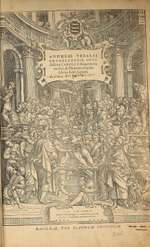
This iconic frontispiece from Andreas Vesalius's 1543 masterpiece, 'De humani corporis fabrica', depicts the author himself performing a public dissection of a female cadaver. Surrounded by a dense crowd of students and scholars in a grand anatomical theater, Vesalius challenges traditional medical authority by demonstrating the importance of direct observation and hands-on investigation. The scene is rich with symbolic detail, including a skeleton presiding over the scene, representing the intersection of life, death, and the pursuit of scientific knowledge.
This celebrated frontispiece depicts Andreas Vesalius performing a public dissection in a packed anatomical theater, a scene that revolutionized medical study by emphasizing direct observation over ancient texts. Vesalius himself is the central figure, shown with his hands inside the cadaver, surrounded by a diverse crowd of onlookers and a symbolic skeleton that presides over the scene. Published in 1543, this woodcut is a masterpiece of Renaissance scientific illustration, capturing the dawn of modern anatomy.
This seminal engraving illustrates William Harvey's 1628 discovery of the circulation of blood. Through these diagrams, Harvey demonstrated how valves in the veins ensure blood flows in only one direction toward the heart, fundamentally overturning centuries of medical belief. The precise use of line and crosshatching captures the physical experiment, showing a hand pressing on a vein to prove the presence of these internal structures.
This woodcut diagram illustrates Nicolaus Copernicus's revolutionary heliocentric model of the universe, placing the Sun (Sol) at the center rather than the Earth. Published in his 1543 work 'De revolutionibus orbium coelestium', it depicts the concentric orbits of the known planets and the outer sphere of fixed stars. This image represents a fundamental turning point in the Scientific Revolution, challenging centuries of geocentric dogma and reshaping our understanding of the cosmos.
Visual Art
Browse all art →17 works of visual art in this collection
 anatomical
Anatomy of the Brain — Boerhaave
After Herman Boerhaave
This engraving depicts six distinct anatomical studies of the human brain and spinal cord, labeled Fig. 1 through Fig. 6, including horizontal cross-sections, a vertical view of the brain stem and spinal cord, and internal structures of the cerebellum.
 anatomical
Anatomy Theatre with Vesalius and Spigelius
After Isbrando de Diemerbroeck
This engraving depicts an anatomical theater scene featuring portraits of historical anatomists Andreas Vesalius and Adriaan van den Spiegel (Spigelius) standing on plinths flanking a central curtain, beneath which lies a cadaver on a table, all framed by an architectural colonnade containing small figures of figures in various stages of dissection.
 anatomical
De Humani Corporis Fabrica — Muscle Figure
Andreas Vesalius
A flayed, dissected human figure is depicted suspended by a rope tied around its neck to a vertical wooden post, with its musculature exposed for anatomical study.
 object
Ivory Skull — Memento Mori
Anonymous (European)
A finely carved anatomical representation of a human skull.
 drawing
Anatomical Drawing — Musculature
Anonymous (French, 18th century)
A drawing featuring a clothed female figure seated on the left and an anatomical human skeleton seated in an identical pose on the right.
 drawing
Anatomical Drawing — Skeletal Structure
Anonymous (French, 18th century)
A pair of side-by-side studies showing a draped male figure in a classical helmet and a matching human skeleton, both posed with their right arms extended in a pointing gesture.
 object
Japanese Anatomical Figure — Ivory
Anonymous (Japanese)
A miniature ivory carving of a human figure serving as an acupuncture anatomical model.
 drawing
Anatomical Studies of Legs
Eugène Delacroix
This drawing depicts several anatomical studies of the human leg and musculature rendered in red and black chalk.
 anatomical
Dissection of the Side of the Neck
G. H. Ford
The image depicts a clinical anatomical dissection of the lateral neck region of a human cadaver, showing the superficial and deep structures including muscles, nerves, and major blood vessels.
 anatomical
Anatomy Theatre with Specimens and Skeleton
J. C. Stadler (after A. Pugin)
Two men stand on the tiered seating of a circular anatomy theatre looking toward a human skeleton suspended by a rope from the center of the domed skylight; a table below holds glass jars containing anatomical specimens.
 anatomical
Dissection of the Trunk — Seated Man
J. Maclise
A coloured lithograph depicting the dissected torso of a seated man, exposing his thoracic and abdominal organs.
 anatomical
Skeleton Leaning on a Spade — after Vesalius
J. Tinney (after Andreas Vesalius)
A human skeleton is depicted standing in a contrapposto pose, leaning its right elbow on the handle of an upright spade.
 anatomical
Skeleton on a Tombstone — after Vesalius
J. Tinney (after Andreas Vesalius)
A human skeleton stands in profile leaning its elbow on a stone pedestal, resting its chin on one hand while the other hand rests upon a detached human skull placed on the pedestal surface.
 anatomical
Skeleton with Right Hand Raised — after Cowper
J. Tinney (after William Cowper)
A line engraving depicting a posterior view of a human skeleton standing on a small mound of earth, with its right arm extended outward and its left arm raised with the index finger pointing upward.
 anatomical
Standing Male Écorché — Back View
T. Milton
A line engraving depicting an anatomical figure (écorché) from the back, showing the muscular system and skeletal structure.
Vesalius published De Humani Corporis Fabrica in 1543, the same year as Copernicus. Harvey discovered blood circulation in 1628. Fabricius found venous valves. Malpighi discovered capillaries in a 34-page pamphlet. This collection traces the revolution in anatomy — from Galen's authoritative errors to direct observation of the human body.
Essential Reading
The foundational texts of this tradition
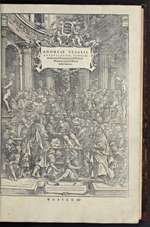
On the Fabric of the Human Body (De Humani Corporis Fabrica)
Andreas Vesalius, 1543
The first edition of Vesalius's 'De Humani Corporis Fabrica' is a foundational text that challenged centuries of anatomical dogma.
Exercitatio anatomica de motu cordis et sanguinis in animalibus
Harvey, William, 1737
Harvey's groundbreaking 'Exercitatio anatomica de motu cordis et sanguinis in animalibus' established the circulation of blood, a cornerstone of the revolution.
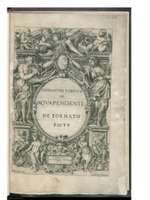
On the Formed Fetus and the Valves of the Veins
Hieronymus Fabricius ab Aquapendente, 1604
This work by Fabricius contains the crucial description of venous valves, which significantly influenced Harvey's later discovery of blood circulation.
Anatomical Observations on the Lungs
Marcello Malpighi, 1661
Malpighi's 'Anatomical Observations on the Lungs' is the work where he described capillaries, completing the understanding of blood circulation at the microscopic level.
Galen, Anatomical Procedures
Galen, 1350
Galen's 'Anatomical Procedures' is his primary anatomical text, representing the authoritative errors that Vesalius directly challenged and corrected.
Important Works
Significant texts that deepen understanding
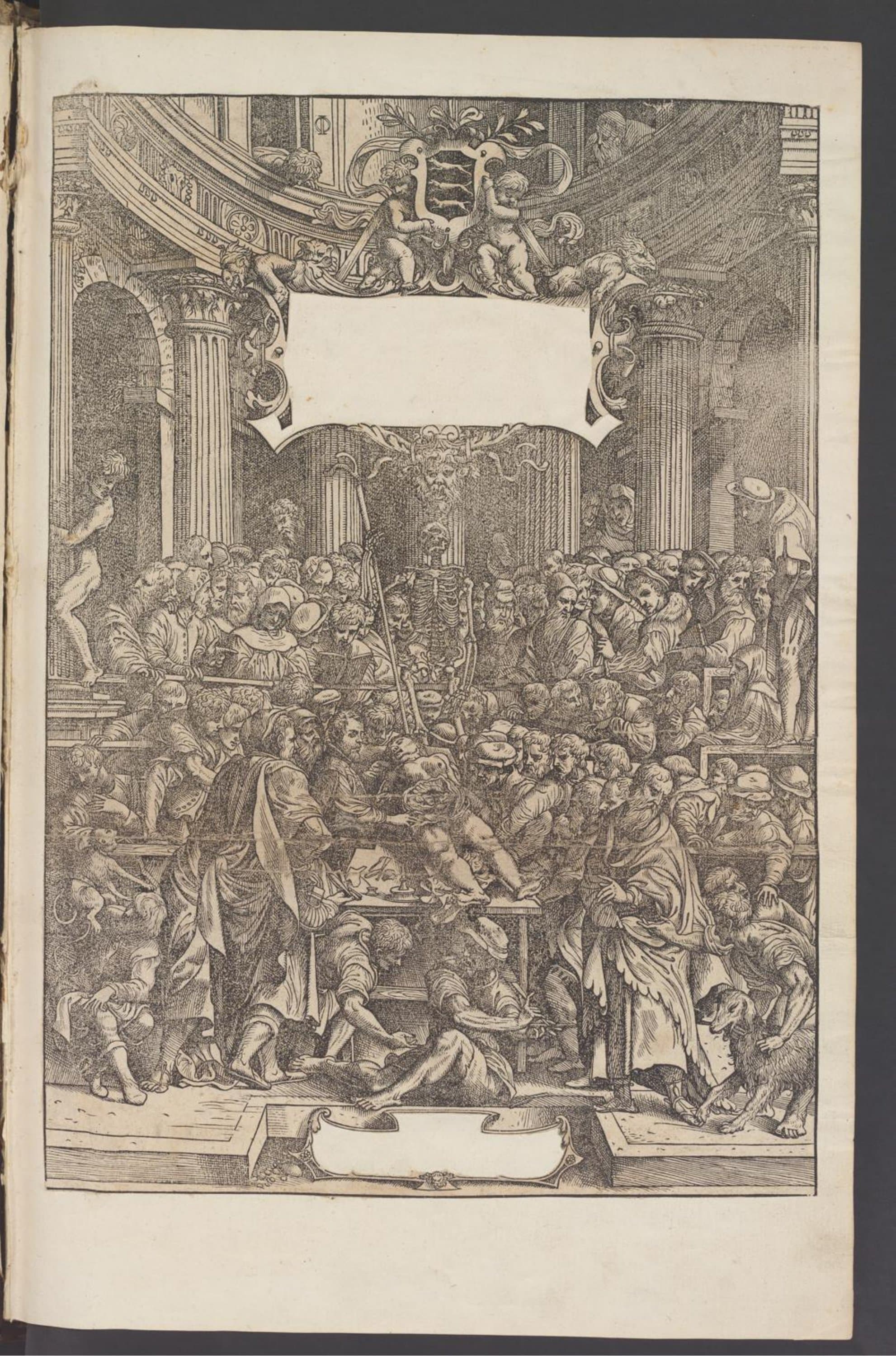
Andreae Vesalii Bruxellensis, scholae medicorum Patavinae professoris, De humani corporis fabrica libri septem
Vesalius, Andreas, 1543
Another title for Vesalius's groundbreaking 'De Humani Corporis Fabrica', essential for understanding the shift to empirical anatomy.
On the Revolutions of the Heavenly Spheres
Nicolaus Copernicus, 1543
Copernicus's work provides crucial historical context for the broader scientific revolution occurring concurrently with Vesalius's anatomical breakthroughs.
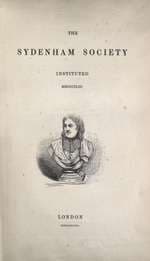
Works of William Harvey (Sydenham Society 1847)
William Harvey, 1894
A significant collected edition of Harvey's works, including his seminal contributions to the understanding of blood circulation.
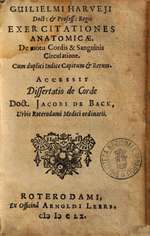
Anatomical Exercises on the Motion of the Heart and the Circulation of Blood
William Harvey, 1660
This significant anatomical work by Harvey demonstrates his broader contributions to the field beyond blood circulation.
Galen (Cambridge, Gonville and Caius College, MS 360/587)
Galen, 1300First Translation
A manuscript representing the long-standing authority of Galen's medical and anatomical texts, which were later challenged by the anatomical revolution.
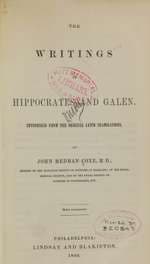
The Writings of Hippocrates and Galen
Hippocrates and Galen, 1549
This collection represents the traditional medical authorities, Hippocrates and Galen, whose views were challenged and corrected by the anatomical revolution.

On the Natural Faculties
Galen, 1916
Galen's 'On the Natural Faculties' is an important physiological work, foundational to his understanding of the body's functions that was later re-evaluated.
All Books
Browse Full Catalog→68 books in this collection