Illustrations
Browse all13 images extracted
This emblem serves as the official mark of the Henry Bradshaw Society, an organization established in 1890 dedicated to the publication of rare liturgical manuscripts. The central heraldic shield, topped by a stag and flanked by the society's initials, reflects the group's commitment to historical continuity and scholarly tradition in the study of Christian worship.
This full-page miniature depicts Christ Enthroned, a central image from the 8th-century Book of Kells. He is shown holding a book of the Gospels, flanked by celestial beings and peacocks, which in early Christian art symbolized incorruptibility and resurrection. The composition is a masterwork of Insular design, utilizing dense Celtic knotwork and stylized zoomorphic patterns to create a sacred, rhythmic space.
This diagram displays the arithmetical characters attributed to the ancient Cymry, or Welsh people, for the numbers one through ten. It serves as a fascinating record of 18th and 19th-century antiquarian efforts to document and preserve perceived ancient Celtic traditions and systems of knowledge.
This table documents the 'Alphabet of Nemnivus,' a unique script recorded in a manuscript dated to A.D. 812. It provides a rare glimpse into early medieval scholarly invention, showing how Latin letters were assigned specific Cymric names and corresponding symbolic characters.
This diagram illustrates the letterforms found on the Cadfan Stone at Towyn, an important early Welsh inscription. It compares these 'rude imitations' of Roman letters with other contemporary scripts, highlighting the development of orthography in early medieval Wales.
This iconic illumination from the Book of Kells (Folio 7v) depicts the Virgin Mary enthroned with the Christ Child. Surrounded by four angels and a small group of figures, the composition is a prime example of Insular art, characterized by its flat, stylized figures and dense, geometric ornamentation. It represents one of the earliest known portraits of the Virgin in a Western manuscript, blending Byzantine influences with Celtic decorative traditions.

Labeled as 'Another mode,' this section illustrates variant forms of ancient Cymric numerals. Of particular interest are the specialized symbols for 'a hundred' and 'a thousand,' which demonstrate the complexity of the symbolic systems being studied by scholars of the period.

This gold-stamped emblem from the cover of 'Poems and Translations from the Ancient Celtic Bards' (1843) encapsulates the romanticized themes of Celtic heritage. It combines symbols of music (the lyre), nobility (the crown), and martial history (the halberd and helmet) within a wreath of national flowers, reflecting the 19th-century fascination with bardic traditions.
The Mabinogion, Táin Bó Cúailnge, and Lebor Gabála Érenn — the mythological cycles of Wales and Ireland.
Essential Reading
The foundational texts of this tradition
The Text of the Mabinogion (Red Book of Hergest)
John Rhys & J.G. Evans (eds.), 1887
A critical edition of 'The Mabinogion,' a cornerstone of Welsh mythological literature and explicitly named in the collection's description.
The Four Ancient Books of Wales (Cymric Poems of the Sixth Century)
William Forbes Skene, 1868
A critical collection of early Welsh poetry, including material that forms the bedrock of Welsh mythological and heroic traditions.

Silva Gadelica: A Collection of Tales in Irish Vol. II (English)
Standish Hayes O Grady, 1892
The second volume of a crucial collection of Irish mythological and heroic tales, complementing the first volume.
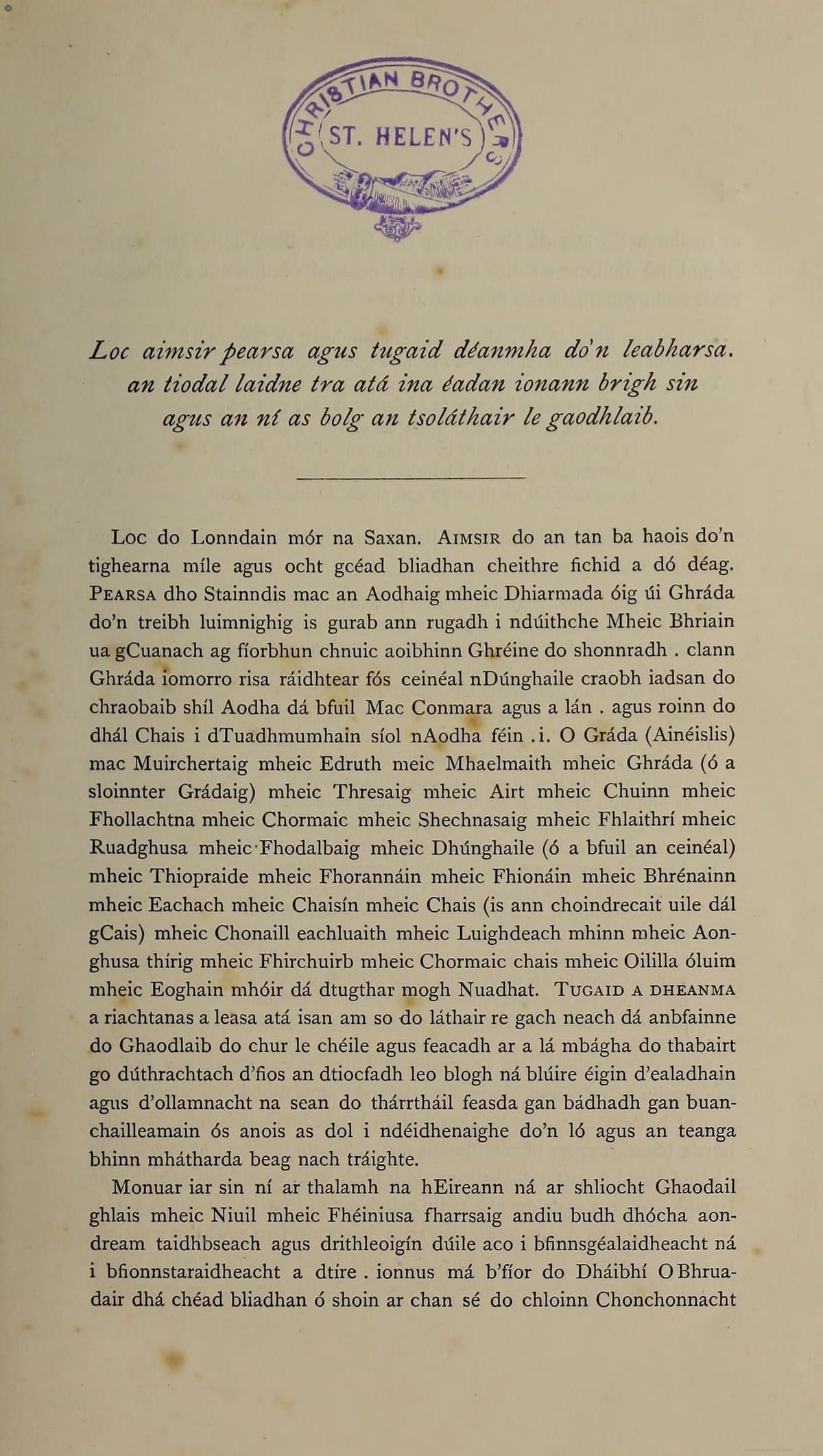
The Metrical Dindshenchas (Irish Place-Lore in Verse)
Edward John Gwynn / Royal Irish Academy, 1903
A fundamental collection of Irish place-name lore, which frequently recounts mythological and heroic narratives explaining the origins of significant locations.
Important Works
Significant texts that deepen understanding
Poems and Translations from the Ancient Celtic Bards
Robert Munro, 1843
It provides access to ancient Celtic poetic traditions, likely including mythological elements, aligning with the collection's focus on Welsh and Irish cycles.
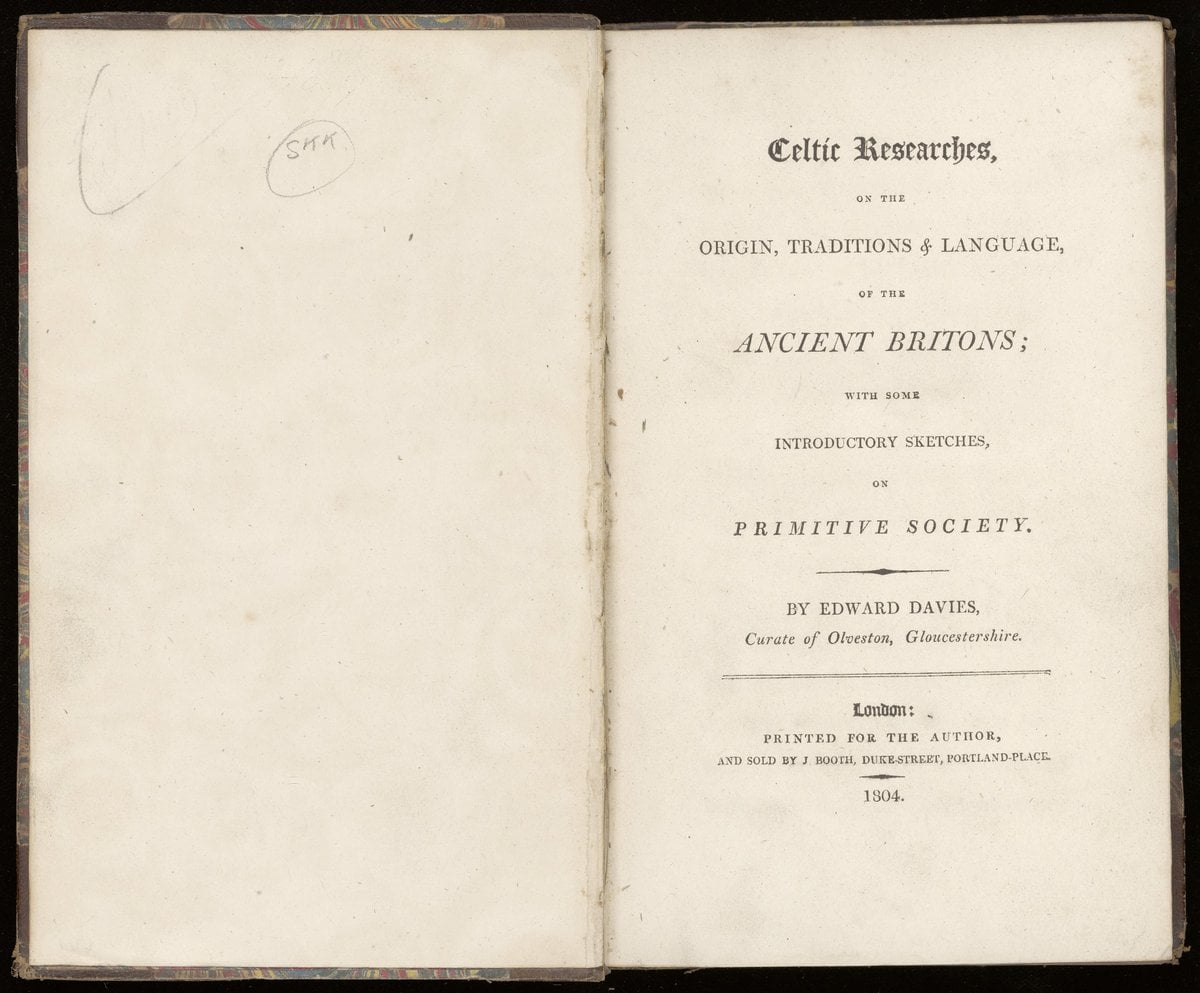
Celtic researches, on the origin, traditions & language of the ancient Britons
Davies, Edward, 1804
An early scholarly work exploring the origins and traditions of ancient Britons, which would include their mythological narratives.
The Barddas
Iolo Morganwg / John Williams Ab Ithel, 1862
Presents documents related to Welsh bardic traditions and theology, which are integral to understanding the context and transmission of Welsh mythological cycles.
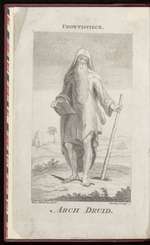
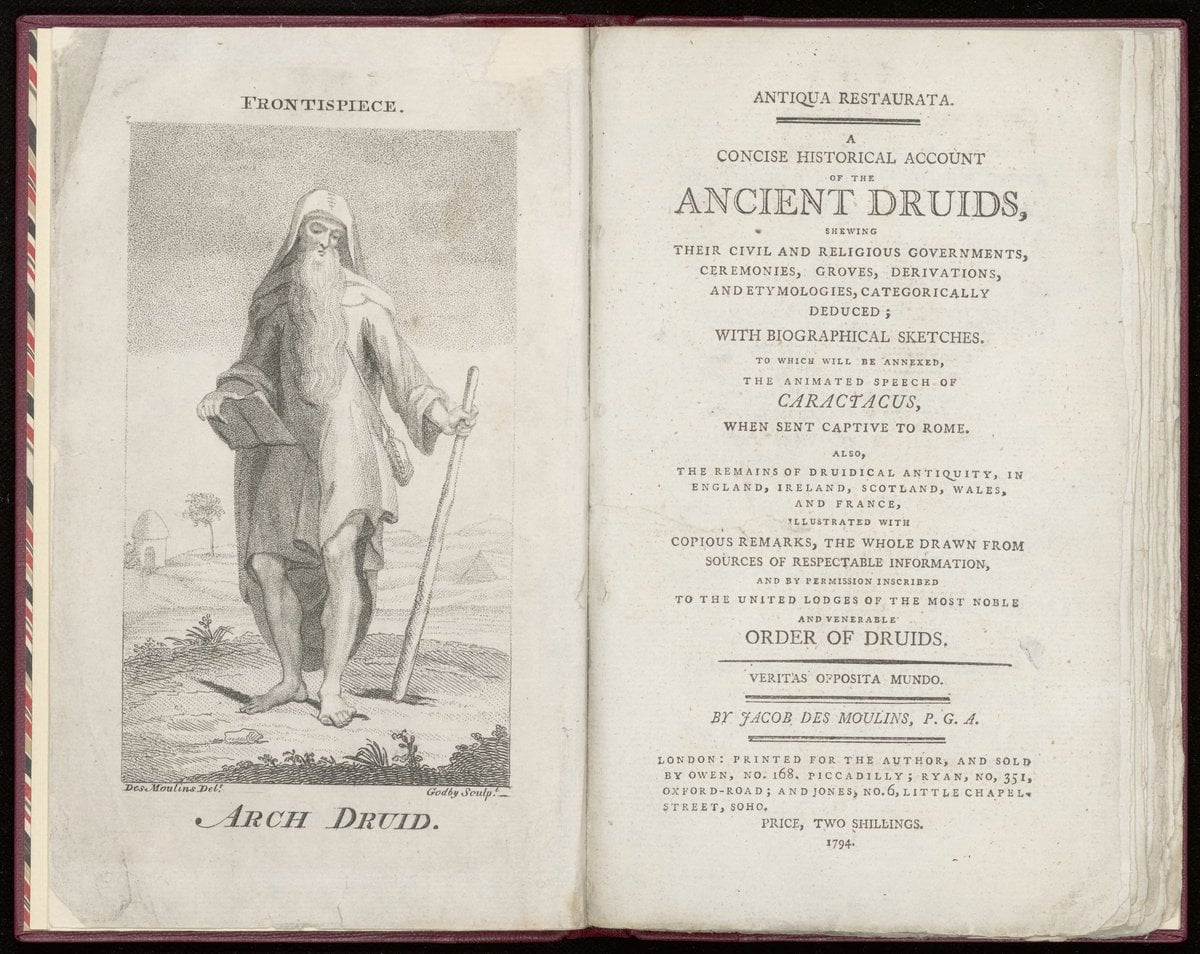
Antiqua restaurata. A concise historical account of the ancient druids
Des Moulins, Jacob, 1794
Provides an early historical account of the ancient Druids, whose religious and cultural practices are foundational to Celtic mythology.