Illustrations
Browse all16 images extracted
The official seal of Columbia University, depicted here on a 1911 title page, features an allegorical figure of Wisdom instructing students. It incorporates the university's motto 'In Lumine Tuo Videbimus Lumen' and reflects the classical traditions of American higher education at the turn of the century.
Figure 2 illustrates the Taijitu, or Yin-Yang symbol, depicting the division of primordial air into light (Yang) and darkness (Yin). This diagram visualizes the dualistic nature of the 'Corporeal Great Extreme' as described in the accompanying philosophical text, representing the formation of the manifest world.
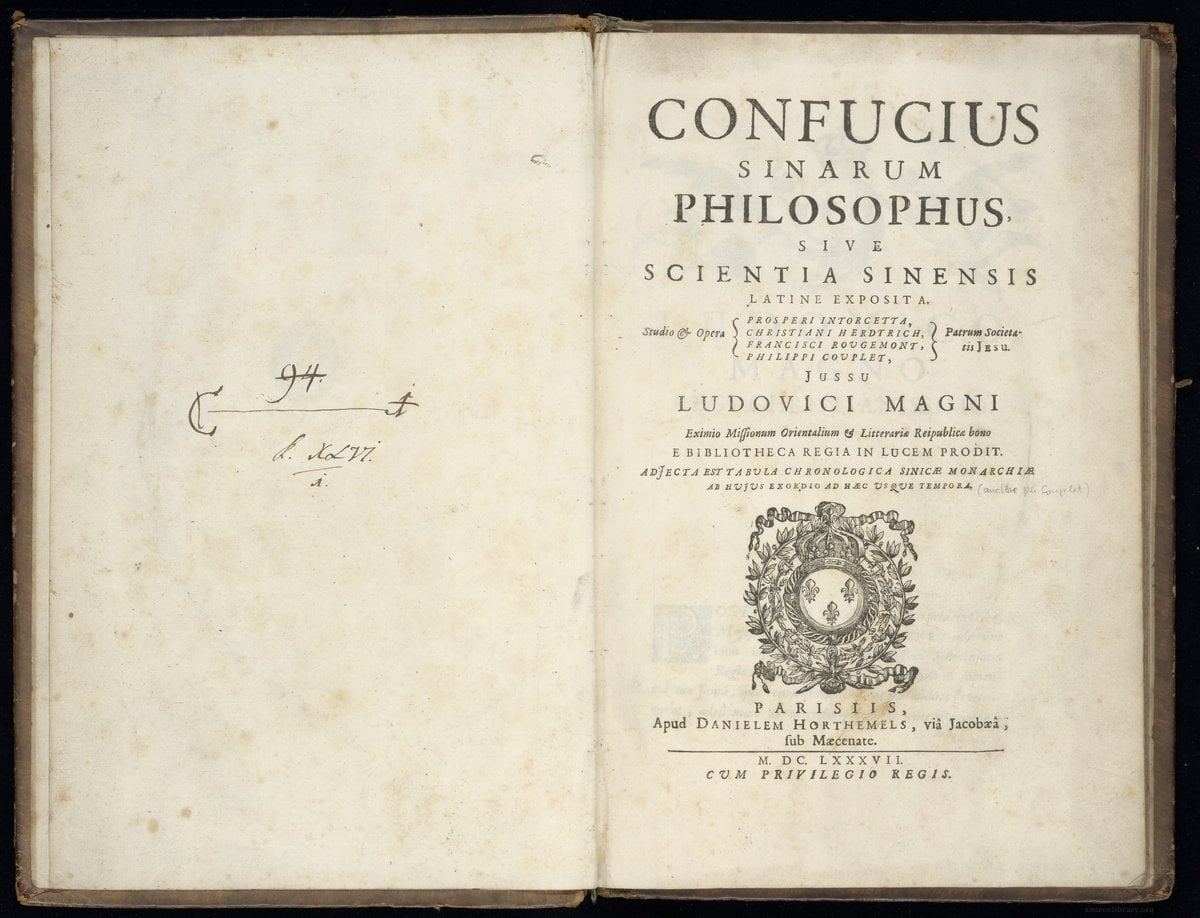
This engraving depicts the royal coat of arms of France, featuring the iconic three fleurs-de-lis under a monarchical crown. Its presence on the title page signifies the patronage of King Louis XIV for this landmark publication, which was instrumental in introducing Confucian philosophy to the Western world.
This engraving depicts the royal arms of France, featuring the iconic three fleurs-de-lis on a shield surmounted by a crown. The shield is encircled by the collar of the Order of the Holy Spirit, signifying the highest level of French chivalry and royal patronage. This mark appears on the title page of 'Confucius Sinarum Philosophus' (1687), indicating the work's dedication to King Louis XIV.
This circular diagram illustrates the 'Khëen' or animated Kosmos as described in the Yih King (I Ching). It depicts the universe moving in a never-ending circle, divided into four parts marked by Chinese characters representing fundamental principles of existence.
Visual Art
Browse all art →5 works of visual art in this collection
 painting
Courtly Odes, Beginning with "Wild Geese" — Book of Odes
Ma Hezhi
A handscroll painting depicting wild geese among reeds, accompanied by calligraphic text from the Shijing (Book of Odes).
 painting
Odes of the State of Bin — Book of Odes
Ma Hezhi
A landscape scroll illustrating the 'Odes of the State of Bin' from the Book of Odes, depicting figures engaged in seasonal agricultural and ritual activities amidst trees and rolling hills.
 painting
Wang Xizhi Watching Geese
Qian Xuan
The calligrapher Wang Xizhi stands on a terrace, observing geese swimming in the water below.
 portrait
Life of Confucius — Illustrated Woodblock Book
Unidentified artist
A woodblock print depicting Confucius accompanied by one of his disciples.
 painting
Beggars and Street Characters
Zhou Chen
A handscroll depicting a procession of beggars, disabled persons, and street performers, accompanied by several sections of calligraphic text.
The Analects, Mencius, the Four Books, and the classical texts that shaped East Asian civilization for two millennia.
Essential Reading
The foundational texts of this tradition
The Confucian Analects
Confucius / James Legge, 1861
This is a foundational translation of the Analects, one of the most important and explicitly mentioned core texts of Confucianism.
Four Books with Collected Annotations
Zhu Xi (朱熹), 1480
This is Zhu Xi's seminal commentary on the Four Books, which became the orthodox interpretation of Confucianism for centuries and is foundational to the collection.
Important Works
Significant texts that deepen understanding
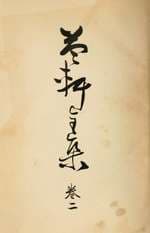
Collected Works (Ekiken Zenshu)
Kaibara Ekiken, 1928
This is a collected work by a prominent Japanese Neo-Confucian philosopher, demonstrating the spread and development of Confucian thought in East Asia.
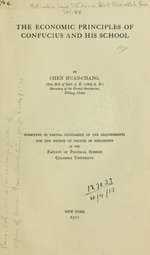
The Economic Principles of Confucius and His School
Chen Huan-Chang, 1911First Translation
This book provides an academic analysis of the economic principles derived from Confucius and his school, directly exploring a facet of Confucianism.
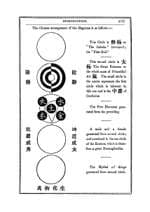
Confucian Cosmogony
Zhu Xi, 1874
This work by Zhu Xi, a pivotal Neo-Confucian philosopher, directly explores the cosmological aspects of Confucian thought.