The Encyclopedists
People who tried to know literally everything.
Illustrations
Browse all500 images extracted
This finely detailed engraving depicts the renowned Jesuit polymath Athanasius Kircher (1602–1680) at the age of 62. Kircher is shown in his clerical robes, framed by an oval border inscribed with his name and titles, with his extensive library visible in the background, symbolizing his vast erudition. The Latin verse on the scroll below praises his intellect, suggesting that neither painter nor poet can fully capture his greatness.
This elaborate frontispiece introduces Athanasius Kircher's study of the Tower of Babel. It depicts a royal figure, likely Nimrod, consulting with an architect over plans for the tower, which rises majestically in the background under the watchful Eye of Providence. The scene reflects the 17th-century fascination with biblical archaeology and the origins of human languages.
This intricate engraving depicts the 'Northern Hemisphere of the Zodiac' as interpreted through the lens of ancient Egyptian mythology by the Jesuit scholar Athanasius Kircher. The circular diagram is densely populated with deities, celestial symbols, and mythological creatures, reflecting Kircher's attempt to synthesize Egyptian wisdom with Western astronomical traditions. It serves as a prime example of the complex, syncretic visual language used in 17th-century hermetic and antiquarian studies.
This striking woodcut from Ulisse Aldrovandi's encyclopedic works depicts a father and son afflicted with hypertrichosis, a condition causing excessive hair growth over the entire body. Identified as members of the famous Gonsalvus family, who were treated as 'wild men' in various European royal courts, these portraits exemplify the Renaissance era's scientific curiosity regarding the 'monstrous' and the limits of human nature.
This woodcut depicts a rhinoceros, heavily influenced by Albrecht Dürer's iconic 1515 print. It appears in Ulisse Aldrovandi's monumental work on natural history, illustrating how early modern scientists relied on established artistic models to represent exotic animals they had never seen in person. The creature is shown with plate-like skin and a dorsal horn, features that became standard in European depictions of the rhinoceros for over two hundred years.
This intricate engraving from Athanasius Kircher's 'Oedipus Aegyptiacus' (1652–1654) serves as a visual catalog of Egyptian iconography as interpreted during the Baroque period. The plate includes diverse figures such as the protective dwarf-god Bes, the syncretic deity Serapis with a grain-measure on his head, and the child-god Harpocrates, illustrating the early European attempt to systematically study and categorize ancient Egyptian culture through a Hermetic lens.

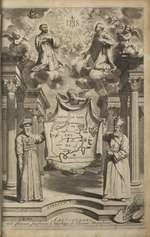
This elaborate frontispiece from Athanasius Kircher's 'China Monumentis Illustrata' (1667) serves as a visual manifesto for the Jesuit mission in East Asia. It depicts the order's founders, Ignatius of Loyola and Francis Xavier, in celestial glory above the missionaries Matteo Ricci and Adam Schall von Bell, who hold a map of China. The composition highlights the intersection of religious devotion and scientific exploration that characterized the Jesuit presence in the Ming and Qing dynasties.

This woodcut depicts the 'Isis multimammea,' a syncretic deity combining elements of the Egyptian Isis and the Ephesian Artemis. The figure is adorned with multiple breasts symbolizing universal fertility, a turreted crown representing her role as a protector of cities, and various animals that signify her dominion over nature. This illustration from Athanasius Kircher's Oedipus Aegyptiacus reflects the 17th-century fascination with ancient mystery religions and symbolic interpretation.

This intricate frontispiece depicts the author, Athanasius Kircher, being guided by the angel Cosmiel on a celestial journey. The scene integrates the divine, represented by the Hebrew Tetragrammaton in the clouds, with the scientific, shown through a detailed diagram of the Tychonic planetary system. It perfectly encapsulates the 17th-century Jesuit worldview, where theological truth and empirical astronomical observation were harmonized.
Athanasius Kircher wrote on Egyptology, magnetism, music, geology, plague, China, the Tower of Babel, and the Ark of Noah — and that's not the complete list. Aldrovandi produced 13 folio volumes of natural history. Gesner catalogued all known animals. Pliny tried to contain all knowledge in 37 books. This collection celebrates the magnificent ambition of the universal scholar.
Essential Reading
The foundational texts of this tradition
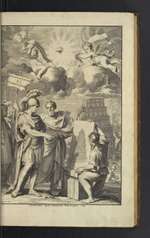
Kircher: Turris Babel (1679)
Athanasius Kircher, 1679First Translation
This work on the Tower of Babel is explicitly mentioned as an example of Kircher's diverse encyclopedic interests.
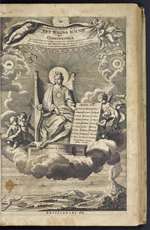
Kircher: Ars Magna Sciendi (1669)
Athanasius Kircher, 1669First Complete Translation
Titled 'The Great Art of Knowing,' this work directly embodies the collection's theme of universal knowledge and ambition.
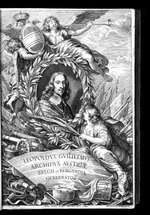
Universal Work on Music (Musurgia Universalis), Vol. I
Athanasius Kircher, 1650First Complete Translation
This first volume of 'Universal Music' represents Kircher's comprehensive work on music, explicitly mentioned in the collection description.
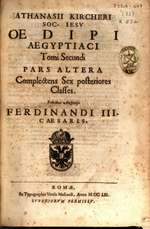
The Egyptian Oedipus, Volume II
Athanasius Kircher, 1653First Translation
This volume of 'The Egyptian Oedipus' represents Kircher's extensive work on Egyptology, a field explicitly mentioned in the collection description.
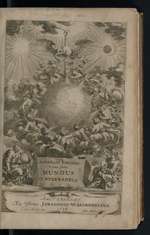
Mundus Subterraneus
Athanasius Kircher, 1678First Translation
Titled 'The Subterranean World,' this work represents Kircher's comprehensive studies in geology, a field explicitly mentioned in the collection description.
Important Works
Significant texts that deepen understanding
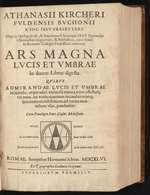
Kircher Ars Magna Lucis et Umbrae (1646)
Athanasius Kircher, 1646First Complete Translation
A comprehensive work on optics and light, this demonstrates Kircher's broad scientific interests as a universal scholar.
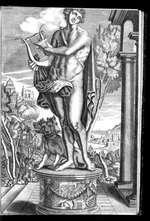
Universal Music-making (Musurgia Universalis), Vol. II
Athanasius Kircher, 1650First Complete Translation
As the second volume of 'Universal Music,' this further demonstrates Kircher's encyclopedic scope in the field of music.
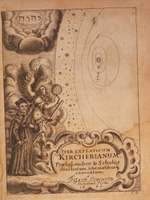
Kircher: Iter Exstaticum Coeleste (1660)
Athanasius Kircher, 1656First Complete Translation
This speculative journey through the cosmos showcases Kircher's wide-ranging cosmological and astronomical interests as a polymath.
Sphinx Mystagoga
Athanasius Kircher, 1676First Translation
This work on Egyptian mysteries complements Kircher's major Egyptology texts, reflecting his deep and varied interest in the subject.
The Coptic or Egyptian Forerunner
Athanasius Kircher, 1636First Translation
An early work, this contributes to Kircher's extensive studies in Egyptology, showcasing his foundational research in the field.
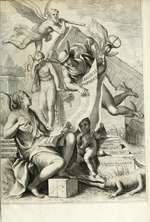
Obeliscus Pamphilius
Athanasius Kircher, 1650First Translation
A detailed study of a specific Egyptian artifact, this is part of Kircher's broader Egyptological research, demonstrating his meticulous approach.
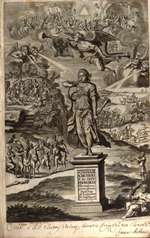
Phonurgia Nova
Athanasius Kircher, 1673First Complete Translation
A pioneering work on the science of sound, 'Phonurgia Nova' reflects Kircher's diverse scientific inquiries and encyclopedic ambition.
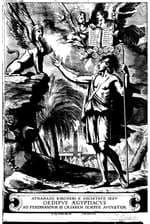
Egyptian Oedipus, Volume 1
Athanasius Kircher, 1652First Complete Translation
As the first volume of his monumental 'Egyptian Oedipus,' this demonstrates Kircher's comprehensive approach to Egyptology.
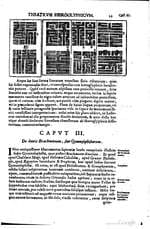
Egyptian Oedipus, Volume 3
Athanasius Kircher, 1654First Complete Translation
As the third volume of his monumental 'Egyptian Oedipus,' this further demonstrates Kircher's comprehensive approach to Egyptology.
All Books
Browse Full Catalog→41 books in this collection