

Enlightenment Political Philosophy
Rousseau, Montesquieu, Vico, Hegel — reason applied to the state and the progress of history
Illustrations
Browse all37 images extracted from 5 books
This portrait depicts the German philosopher, poet, and playwright Friedrich Schiller. It captures the author in a contemplative, youthful pose, reflecting the Romantic ideals of genius and intellectual depth that characterize his work on aesthetic education.
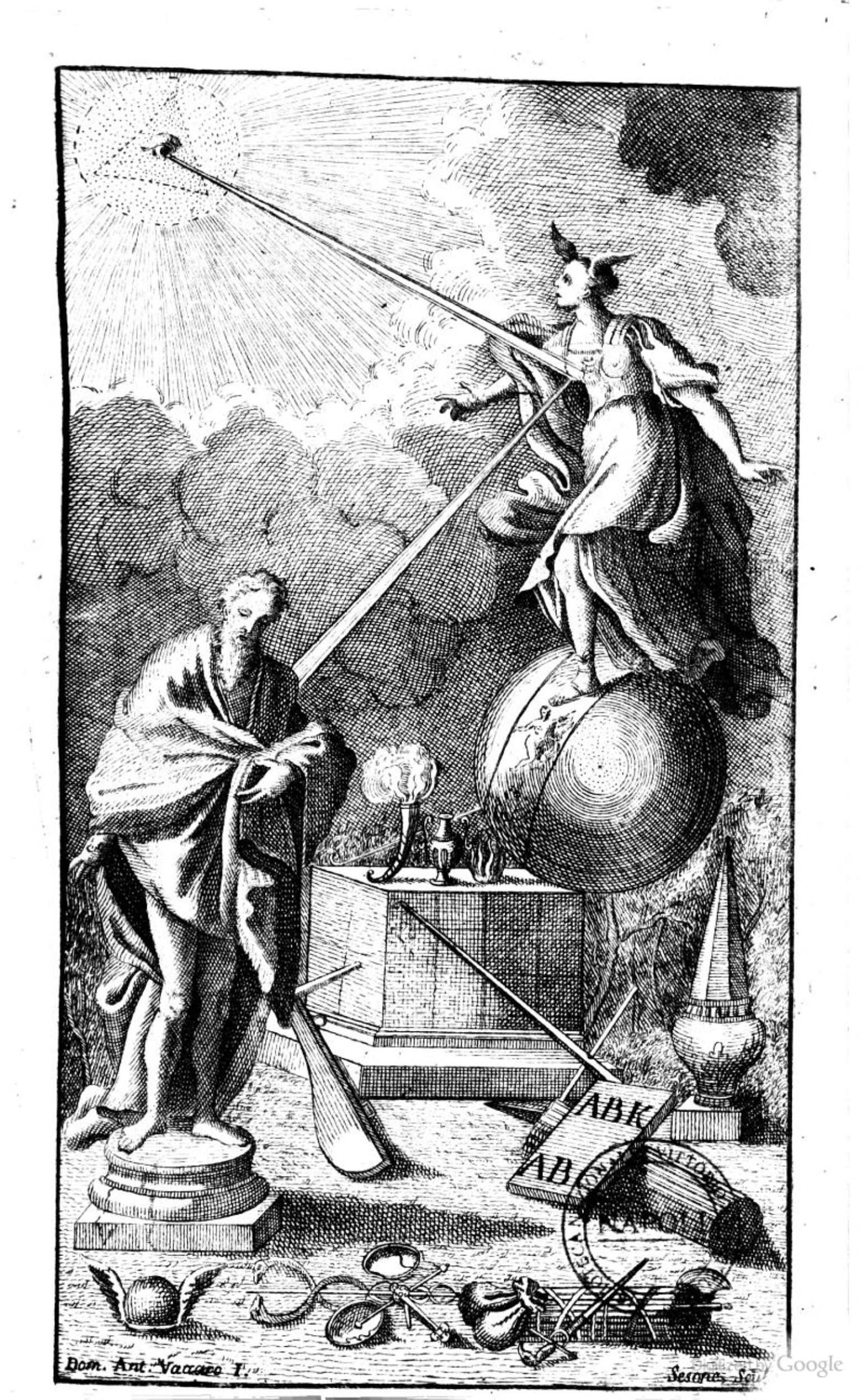
This intricate allegorical engraving depicts the transmission of divine wisdom to the earthly realm. A winged figure, likely representing Eloquence or Reason, stands atop a globe and receives a direct beam of light from the Eye of Providence, while a contemplative philosopher figure stands nearby amidst various symbols of trade, navigation, and learning. The composition masterfully employs light and a dense array of symbolic objects—including a caduceus, scales, and a rudder—to convey a complex message about the relationship between divine inspiration and human endeavor.
This woodcut illustration depicts a large group of seventeen numbered individuals gathered in an interior setting, possibly for a formal meeting or a social event. The architectural details, such as the arched doorway and chandelier, suggest a grand room. The numbering of the figures indicates that this image likely served as a key to identify specific historical personages in a larger, more detailed composition.
This intricate scene, derived from the 13th-century Psalter of St. Louis, illustrates the dual themes of the Resurrection and the Weighing of Souls. The upper register shows angels sounding trumpets to summon the dead, while the lower register depicts the Archangel Michael performing the psychostasia, or the weighing of souls, a quintessential motif in medieval eschatological art.
This intricate frontispiece serves as a visual synthesis of Pierre Jurieu's critical history of religious dogmas. It juxtaposes scenes of biblical revelation, such as Moses receiving the tablets, with depictions of ancient temple rituals and pagan cultic practices, reflecting the Enlightenment-era interest in the comparative study of religious traditions.
This intricate engraving presents a dense allegorical landscape centered on the pursuit of divine or philosophical truth. A winged figure, likely representing Fame or Divine Wisdom, stands atop a globe and directs a beam of light from the Eye of Providence toward the terrestrial realm. Surrounding the figures are numerous symbols of human endeavor and knowledge, including books, a caduceus, and navigational tools, suggesting a synthesis of spiritual guidance and worldly learning.

This intricate engraving, based on a composition by Pieter Bruegel the Elder, depicts the dramatic confrontation between St. James the Elder and a chaotic assembly of diabolical figures. The work exemplifies the sixteenth-century fascination with the grotesque and the supernatural, blending religious narrative with the surreal, nightmarish imagery characteristic of the period's exploration of the occult.
All Books
Browse Full Catalog→30 books in this collection