
Illustrations
Browse all1 images extracted
Fechner invented psychophysics — the mathematical measurement of the relationship between physical stimuli and subjective sensation. His Elemente der Psychophysik (1860) gave psychology its first rigorous experimental method. But Fechner was no mere laboratory scientist. His Zend-Avesta (1851) argues that consciousness pervades all of nature, from plants to planets. His Nanna, oder über das Seelenleben der Pflanzen makes the case that plants have souls. His Das Büchlein vom Leben nach dem Tode outlines a three-stage theory of existence in which death is a second birth into a wider field of consciousness.
This dual nature — the meticulous experimentalist who was also a cosmic mystic — makes Fechner a pivotal figure. William James called him 'a German professor who could be both a great scientist and a mystic.' His psychophysical law (sensation = k log stimulus) remains foundational in sensory psychology, while his panpsychist philosophy is experiencing a revival through integrated information theory and the modern consciousness debate. Source Library holds 18 of his works, nearly all translated for the first time into English — from the technical In Sachen der Psychophysik and Revision der Hauptpuncte der Psychophysik to the visionary Über die Seelenfrage and his study of Jakob Böhme.
Essential Reading
The foundational texts of this tradition
On the Things of Heaven and the Afterlife
Gustav Theodor Fechner, 1851First Complete Translation
Fechner's visionary cosmology — consciousness pervades all nature from atoms to stars. The Avesta of a scientific mystic who saw no contradiction between measurement and metaphysics.
Nanna, or On the Soul-Life of Plants
Gustav Theodor Fechner, 1848First Translation
A systematic argument that plants possess souls — sensation, movement toward light, response to environment understood as evidence of inner life.

Dream Pool Essays
Shen Kuo, 1088
Fechner's concise three-stage theory: earthly life, death as a narrowing, and a third existence as expanded cosmic consciousness. His most personal and widely read work.
Important Works
Significant texts that deepen understanding
Elements of Psychophysics, Volume II
Gustav Theodor Fechner, 1860First Complete Translation
The second volume of Elemente — extending psychophysical methods to higher mental processes and aesthetic experience.
Revision of the Main Points of Psychophysics
Gustav Theodor Fechner, 1882First Complete Translation
Fechner's defense and refinement of his psychophysical law against critics — a masterclass in scientific methodology.
In Matters of Psychophysics
Gustav Theodor Fechner, 1877First Translation
The detailed response to objections raised against the Elemente — clarifying the philosophical foundations of psychophysics.

On the Soul-Question
Gustav Theodor Fechner, 1861
A journey through the visible world in search of the invisible — Fechner's most sustained argument for universal ensoulment.
Also Notable
Jakob Böhme: His Life and Writings
Gustav Theodor Fechner, 1857First Translation
Introduction to Aesthetics, Volume 2
Gustav Theodor Fechner, 1876First Translation
The Three Motives and Grounds of Faith
Gustav Theodor Fechner, 1863First Translation
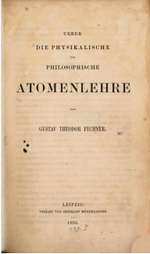
On the Physical and Philosophical Atomic Theory
Gustav Theodor Fechner, 1855
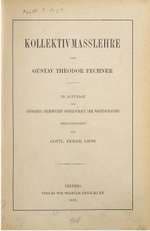
Theory of Collective Measurement
Gustav Theodor Fechner, 1897First Translation
All Books
Browse Full Catalog→16 books in this collection