


The Indian Mathematical Tradition
Where zero was invented and negative numbers first described.
Illustrations
Browse all187 images extracted
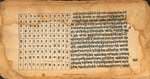
This diagram illustrates the Meru Prastara, an ancient Indian mathematical concept equivalent to Pascal's triangle. Found in Bhaskara II's 12th-century work 'Lilavati', it demonstrates the sophisticated understanding of combinatorial analysis in classical Indian mathematics centuries before similar developments in Europe.
A page from a 1912 scholarly edition of the 9th-century Sanskrit mathematical treatise 'Gaṇitasārasaṅgraha' by Mahāvīra. It features numbered diagrams illustrating various curvilinear areas such as conchiform, concave, and convex shapes, alongside different forms of the annulus. The text serves to translate and preserve medieval Indian geometric concepts for a modern academic audience.
This geometric diagram illustrates fundamental trigonometric concepts from Bhaskaracharya II's 12th-century treatise, Siddhanta Shiromani. It depicts a quadrant of a circle with labels for 'jya' (sine) and 'utkramajya' (versine), demonstrating the advanced mathematical knowledge of medieval India.
A series of right-angled triangles illustrating the Pythagorean theorem applications from the Lilavati.
This hand-drawn geometric diagram, highlighted in red, is a technical illustration from Kamalakara's 'Siddhanta Tattva Viveka'. It depicts spherical trigonometric principles used in 17th-century Indian astronomy to calculate celestial movements and planetary positions.
This geometric diagram illustrates astronomical principles from Bhaskaracharya II's 12th-century treatise, Siddhanta Shiromani. It depicts the relationship between different celestial circles, likely used to calculate planetary positions or eclipses, showcasing the advanced state of medieval Indian mathematics.

This circular diagram illustrates the method for determining the lords of the year, month, day, and hour (Hora) as described in the Surya Siddhanta, a foundational text of Indian astronomy. The diagram maps the sequence of the days of the week (Vara) and their corresponding planetary rulers, providing a visual aid for complex calendrical calculations.

A page from the 1912 English translation of the 'Gaṇitasārasaṅgraha', a seminal Sanskrit mathematical treatise authored by the 9th-century Jain scholar Mahāvīrācārya. This section of Chapter VII, 'Calculation Relating to the Measurement of Areas,' provides a systematic classification of triangles—equilateral, isosceles, and scalene—illustrated with precise geometric line diagrams. The text demonstrates the sophisticated state of medieval Indian geometry and the formal categorization of 'trilateral,' 'quadrilateral,' and 'curvi-linear' forms.

This circular diagram from the Surya Siddhanta illustrates the traditional Indian astronomical understanding of the planets' order based on their distance from Earth. It maps out the sequence of planetary rulers for hours, days, and years, reflecting the intricate mathematical and cosmological systems of ancient India.
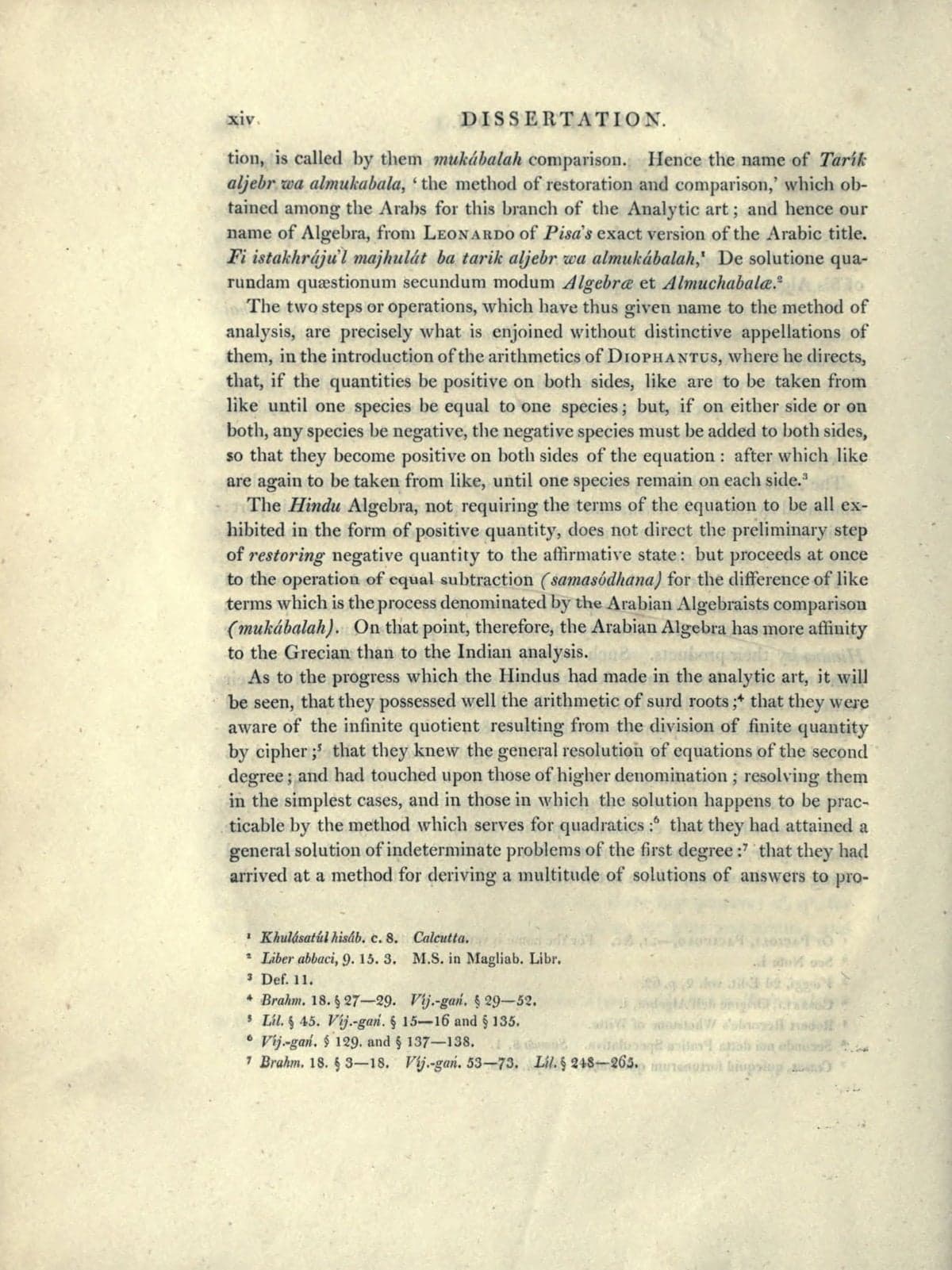
Brahmagupta's Brahmasphutasiddhanta (628 AD) gave rules for computing with zero and negative numbers — centuries before Europe. Bhaskara II solved quadratic equations. Mahavira wrote the world's first combinatorics. The Sulba Sutras encoded geometry in ritual altar construction. This collection gathers the foundational texts of Indian mathematics.
Essential Reading
The foundational texts of this tradition
Brahmasphutasiddhanta (Complete Sanskrit Text)
Brahmagupta, 1966
This is the seminal work by Brahmagupta, explicitly cited in the collection description for its foundational contributions to zero and negative numbers.
Lilavati (The Beautiful) of Bhaskaracharya
Bhaskara II; Khemraj 1908, 1908
Lilavati is a foundational text by Bhaskara II, renowned for its contributions to arithmetic and its pedagogical approach.
Algebra of Bhaskara II
Bhaskara II; Jivanatha Jha, 1949
Bijaganita is a core text by Bhaskara II, directly addressing the collection's theme of solving quadratic equations.
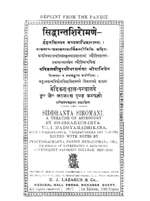
The Crest-Jewel of Siddhantas
Bhaskara II; Muralidhara Jha, 1917
This comprehensive work by Bhaskara II is a cornerstone of Indian mathematical and astronomical tradition, containing his major mathematical treatises.
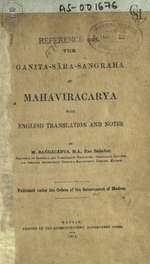
The Compendium of the Essence of Mathematics
Mahavira; M. Rangacharya, 1912First Translation
This is the seminal work by Mahavira, explicitly mentioned in the collection description for its pioneering contributions to combinatorics.
Important Works
Significant texts that deepen understanding
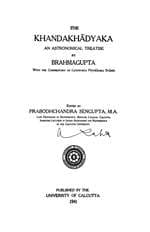
Khandakhadyaka: An Astronomical Treatise
Brahmagupta; Prabodh Chandra Sengupta, 1941
This astronomical treatise by Brahmagupta is important as his works often integrate significant mathematical concepts relevant to the collection.
The Wonder of Calculation (Karana Kutuhala)
Bhaskara II, 1928First Translation
This astronomical work by Bhaskara II is relevant as his treatises often include significant mathematical developments.

Siddhanta Shiromani
Unknown, 1867
This is an edition of Siddhanta Shiromani, a foundational mathematical-astronomical treatise by Bhaskara II.

Siddhanta Shiromani Vasana Bhashya
Chintamani, 1800First Translation
This commentary on Bhaskara II's Siddhanta Shiromani provides valuable insights into a foundational mathematical-astronomical text.
Commentary on the Great Compendium
Varahamihira, 966First Complete Translation
This commentary by Varahamihira contributes to the early Indian astronomical and mathematical tradition.
All Books
Browse Full Catalog→18 books in this collection