The Invention of Method
How "try it and see" replaced "Aristotle said so."

Illustrations
Browse all335 images extracted
This elaborate engraving depicts the Royal Coat of Arms of Great Britain, likely from the reign of King George. It features the traditional lion and unicorn supporters alongside military motifs like cannons and flags, symbolizing the sovereign's power and authority over land and sea.
This engraving depicts Robert Morison (1620–1683), a pioneering Scottish botanist and physician. He is framed by an intricate wreath of diverse flora, symbolizing his monumental contributions to plant taxonomy. The pedestal below records his life dates and features his coat of arms, marking this as a formal commemorative portrait, likely serving as a frontispiece for one of his botanical works.
This intricate diagram illustrates René Descartes' influential vortex theory of planetary motion from his 1644 work, 'Principia Philosophiae'. It depicts the universe as a plenum filled with swirling 'subtle matter' that carries planets around their respective suns, offering a purely mechanical explanation for celestial movements that preceded Newton's theory of universal gravitation.
This intricate printer's mark for Giorgio Marescotti features a galleon in full sail, a common symbol for the successful journey of knowledge through publishing. Flanked by satyrs and surmounted by a scholarly figure, the emblem is framed by a Latin motto, reflecting the humanist traditions of 16th-century Florence.
This detailed engraving serves as the title vignette for Robert Morison's 'Plantarum Historiae Universalis Oxoniensis'. It depicts Minerva, the goddess of wisdom and patron of the arts and sciences, seated before a panoramic view of Oxford, including the Sheldonian Theatre. Surrounded by books and botanical specimens, she symbolizes the scholarly pursuit of natural history within the university setting.
This iconic frontispiece for Francis Bacon's 'Novum Organum' (1660 edition) depicts a ship sailing beyond the Pillars of Hercules, which traditionally marked the limits of the known world in antiquity. It serves as a powerful metaphor for the advancement of knowledge through empirical observation and the scientific method, moving past the boundaries of classical thought. The Latin motto below, 'Multi pertransibunt & augebitur scientia' (Many shall pass through and knowledge shall be increased), reinforces this theme of intellectual exploration and the dawn of the scientific revolution.

This emblem is the official seal of Brigham Young University, prominently featuring a beehive, a symbol of industry and community central to Latter-day Saint iconography. The surrounding text includes the university's name and its motto, 'The Glory of God is Intelligence,' reflecting the institution's core values since its founding in 1875.

This elaborate woodcut headpiece introduces a formal dedication to King Charles I. It features a central vase with overflowing foliage, flanked by a heraldic unicorn and thistles, symbols closely associated with the Scottish crown and the Stuart dynasty.

This intricate diagram illustrates René Descartes' influential vortex theory, which attempted to explain planetary motion through the mechanical interaction of celestial matter. The interlocking spheres represent vortices of 'subtle matter' that carry planets around their respective suns, reflecting a purely mechanical view of the universe that preceded Newton's theory of universal gravitation.
Bacon's Novum Organum proposed a new logic of discovery. Descartes' Discourse on Method demanded radical doubt. Galileo's Two New Sciences replaced philosophical argument with experiment. The Royal Society institutionalized it. This collection traces the invention of the scientific method — the idea that shaped the modern world.
Essential Reading
The foundational texts of this tradition
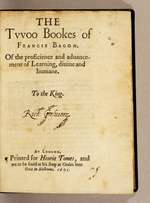
The Advancement of Learning (1605 first edition)
Bacon, Francis, 1605
Francis Bacon's The Advancement of Learning lays out his vision for the reform of knowledge and the promotion of empirical inquiry.
Francisci Baconi Baronis de Verulamio Novum organum scientiarum
Bacon, Francis, 1779
Bacon's Novum Organum is a foundational text that explicitly proposed a new inductive logic of discovery to replace Aristotelian deduction.
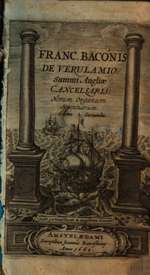
The New Organon
Bacon, Francis, 1660
This edition of The New Organon further emphasizes Bacon's pivotal role in advocating for a new empirical approach to knowledge.
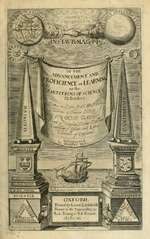
Of the Advancement and Proficience of Learning (1640)
Francis Bacon, 1763
This edition of The Advancement of Learning further illustrates Bacon's comprehensive program for intellectual reform and scientific progress.
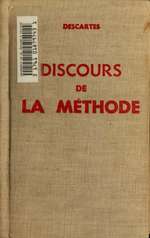
Discourse on the Method and Metaphysical Meditations
René Descartes, 1900
Descartes' Discourse on Method is a foundational text that introduced radical doubt and a new rationalist approach to knowledge, influencing the scientific method.
Important Works
Significant texts that deepen understanding

The System of Saturn
Christiaan Huygens, 1659
Huygens' astronomical work exemplifies the application of the new scientific method through observation and mathematical reasoning.
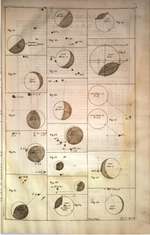
British Celestial History, Vol. 1
John Flamsteed, 1725First Complete Translation
Flamsteed's work as the first Astronomer Royal represents the institutionalization and application of the scientific method in detailed astronomical observation.
The Works of Blaise Pascal, Vol. I
Blaise Pascal, 1923First Complete Translation
Pascal's contributions to physics and mathematics, particularly his work on the vacuum, exemplify the experimental and rational approaches of the new method.

Mechanics
Aristotle, 1497
Aristotle's Mechanica exemplifies the ancient approach to understanding natural phenomena that the new method aimed to supersede.
Physics, Metaphysics, and Ethics
Aristotle, -335
These foundational works of Aristotle represent the established philosophical and scientific authority challenged by the new method.
Fratris Rogeri Bacon ... opus maius ... ex MS. codice Dubliniensi
Bacon, Roger, 1733
Roger Bacon's Opus Maius is a significant precursor, advocating for observation and experiment centuries before the full development of the scientific method.
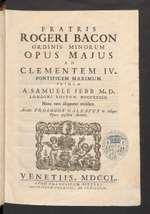
Fratris Rogeri Bacon ... Opus maius ad Clementem IV ...
Jebb, Samuel, 1750
This edition of Roger Bacon's Opus Maius further highlights his early advocacy for empirical inquiry and mathematical reasoning.
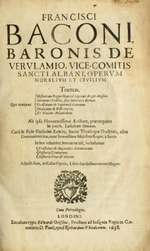
The Moral and Civil Works of Francis Bacon
Bacon, Francis, 1638
This work offers further insight into Francis Bacon's broader intellectual contributions beyond his core scientific methodology.
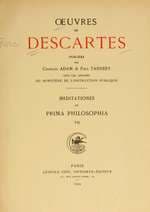
Collected Works of René Descartes, Volume 7: Meditations on First Philosophy
René Descartes, 1904
Descartes' Meditations on First Philosophy demonstrates his method of radical doubt to establish certain knowledge, a key aspect of his philosophical method.
All Books
Browse Full Catalog→52 books in this collection