Illustrations
Browse all153 images extracted
This plate, published in the Philosophical Transactions of the Royal Society in 1804, exemplifies the multidisciplinary nature of early modern science. It juxtaposes a large-scale anatomical dissection of a bird's digestive tract with archaeological artifacts and microscopic observations, reflecting the era's drive to categorize and understand the natural and historical world through meticulous visual documentation.
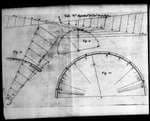
This engraved plate, titled 'Tab. V,' presents three complex astronomical diagrams illustrating the hypotheses of Sir Christopher Wren. These technical drawings demonstrate the sophisticated geometric methods used in the late 17th century to model celestial phenomena, such as the Earth's position relative to the ecliptic plane throughout the year. Published in Robert Hooke's 1678 work, it reflects the collaborative spirit and rigorous observational science of the early Royal Society.
This intricate title page engraving from Charles Plumier's 1703 botanical treatise depicts the sun, a symbol of enlightenment and reason, illuminating a scholar's desk. The imagery serves as a visual metaphor for the scientific endeavor of the work: to bring the flora of the Americas into the light of European botanical classification.
This plate from Robert Hooke's 1674 treatise features detailed astronomical diagrams, including a striking depiction of a comet over a building silhouette and observations of Jupiter's surface. These illustrations represent Hooke's meticulous empirical approach to proving the Earth's motion through celestial observation, showcasing the intersection of art and science in the early modern period.
This finely detailed engraving serves as a decorative tailpiece, illustrating an allegorical scene. It depicts a seated figure with a radiant halo, possibly representing Wisdom or a mythological deity, flanked by a peacock and a serpent, symbols often associated with immortality and prudence.
This plate from Robert Hooke's 1676 treatise illustrates various optical configurations and mechanical components for scientific instruments like the helioscope. Hooke, a key figure in the Scientific Revolution, used these precise engravings to communicate complex designs for safely observing the sun and improving astronomical measurements.

This central gold-stamped seal belongs to William Wyndham Grenville, Baron Grenville, during his tenure as Chancellor of the University of Oxford. The oval emblem features a detailed coat of arms surmounted by a coronet, encircled by the Latin inscription 'SIGILL. W. W. BARONIS GRENVILLE CANCELLARII ACADEMIÆ OXONIENSIS,' marking the volume as part of a prestigious collection.

This detailed copperplate engraving depicts a series of technical diagrams for scientific instruments, likely from a late 17th-century treatise on mechanics or surveying. The illustration features cross-sectional views of leveling devices and a complex adjustable mechanism equipped with a graduated scale and fine-threaded screw. Such plates were essential for communicating the design and operation of new experimental tools during the Scientific Revolution.

This engraving illustrates the use of a perspective-drawing instrument to accurately capture a landscape. A gentleman is shown tracing the outlines of a distant scene—complete with mountains and a fortified town—onto a screen, demonstrating the intersection of art and optical science in the early modern period. Such devices were precursors to more advanced optical tools and reflect the era's fascination with scientific precision in artistic representation.
Curator of Experiments for the Royal Society. Architect of the Monument to the Great Fire. Microscopist who named cells. Clockmaker who formulated Hooke's Law. Robert Hooke's complete works — the Cutler Lectures, Micrographia, the Diary, the posthumous papers — reveal a mind that touched everything and was overshadowed by Newton.
Essential Reading
The foundational texts of this tradition

The Diary of Robert Hooke, 1672-1680
Robert Hooke, ed. Henry W. Robinson & Walter Adams, 1968First Translation
Hooke's personal diary provides invaluable insight into his daily scientific activities, observations, and interactions, as highlighted in the collection description.
Lectiones Cutlerianae
Robert Hooke, 1679
These lectures, endowed by Sir John Cutler, represent a significant body of Hooke's public scientific contributions and are explicitly named in the collection's thesis.
Lectures de Potentia Restitutiva, or of Spring
Robert Hooke, 1678
This foundational work presents Hooke's Law of elasticity, a cornerstone of his contributions to physics and mechanics, directly referenced in the collection's subtitle.
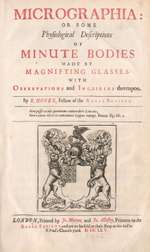
Micrographia
Hooke, Robert, 1665
Hooke's seminal work, Micrographia, is explicitly named in the collection's thesis as a key text where he named cells and detailed microscopic observations.
Micrographia
Hooke, Robert, 1665
This edition of Micrographia is a core text, central to Hooke's legacy as a microscopist and the coiner of the term 'cell', as emphasized in the collection's description.
Important Works
Significant texts that deepen understanding
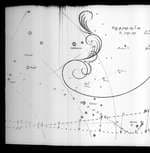
An Attempt to Prove the Motion of the Earth from Observations
Robert Hooke, 1674
This work showcases Hooke's contributions to astronomy and his attempts to prove the Earth's motion, a key area of his scientific inquiry.
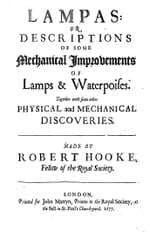
Lampas, or Descriptions of Mechanical Improvements of Lamps and Waterpoises
Robert Hooke, 1677
This publication demonstrates Hooke's practical mechanical inventions and his role as an innovator in various fields.
Philosophical Experiments and Observations
Robert Hooke, 1726
This posthumous collection further compiles Hooke's diverse experimental work and observations, contributing to the understanding of his polymathic mind.
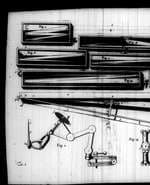
A Description of Helioscopes, and Some Other Instruments
Robert Hooke, 1676
This work highlights Hooke's expertise in designing and improving scientific instruments, a crucial aspect of his experimental methodology.
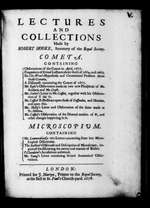
Lectures and Collections
Robert Hooke, 1678
This collection provides further insight into Hooke's various lectures and scientific compilations, reflecting his broad intellectual pursuits.
Micrographia Restaurata
Robert Hooke, 1745
This Latin edition or restoration of Micrographia underscores the international impact and continued relevance of Hooke's groundbreaking microscopic observations.
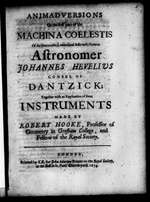
Animadversions on the First Part of the Machina Coelestis
Robert Hooke, 1674
This work demonstrates Hooke's active engagement with and critical analysis of contemporary astronomical theories and instruments.
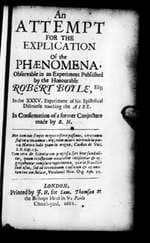
An Attempt for the Explication of the Phaenomena
Robert Hooke, 1661
This work reflects Hooke's efforts to explain various natural phenomena, showcasing his broad scientific curiosity and theoretical contributions.
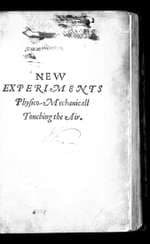
New Experiments Physico-Mechanical (1660)
Robert Boyle, 1660
This work by Robert Boyle is highly relevant as Hooke served as his assistant and built the air pump central to these experiments, highlighting their collaborative scientific environment.