



Illustrations
Browse all56 images extracted from 4 books
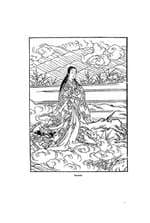
This woodcut illustration depicts Izanami, the primordial goddess of creation and death in Japanese mythology. She is shown in elegant, patterned robes, standing amidst stylized clouds and mountains, reflecting traditional Japanese artistic conventions for representing divine beings. This image serves as a visual accompaniment to the 'Nihongi,' one of Japan's oldest historical and mythological chronicles.
This woodcut depicts the central Shinto myth of the Sun Goddess Amaterasu being enticed out of the Rock-cave of Heaven. The scene shows various deities collaborating to restore light to the world, featuring key symbols such as the sacred mirror hanging on a tree and a crowing rooster.
This evocative illustration depicts a pivotal moment in Japanese mythology: the sun goddess Ama-terasu emerging from the Heavenly Rock Cave. Lured by the ribald dancing and laughter of the goddess Uzume, Ama-terasu's return brings light back to a world plunged into darkness. The artist uses a dramatic contrast between the radiant goddess and the shadowy figures below to emphasize the divine nature of the event.
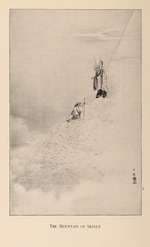
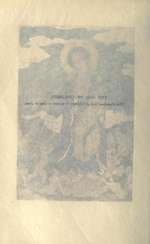
This illustration depicts a compassionate Buddhist deity, likely Jizo Bosatsu, the protector of children and travelers. He is shown standing upon a lotus pedestal, radiating light and surrounded by the souls of children in a mountainous landscape, reflecting traditional Japanese religious iconography and the syncretic nature of early 20th-century scholarly publications on Eastern literature.
This woodcut illustration depicts Izanagi, one of the primary creator deities in Japanese mythology, as chronicled in the Nihongi. He is portrayed in ornate traditional robes, standing amidst stylized clouds and a landscape, reflecting the Meiji-era artistic interpretation of ancient Shinto legends. This image serves as a visual representation of the foundational myths of Japan as presented in W.G. Aston's 1896 translation.
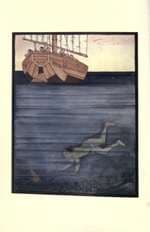
This woodcut illustration depicts a Shinto deity amidst turbulent waves, likely representing a figure associated with the sea such as Susanoo. The dynamic and expressive lines of the water emphasize the power of nature, reflecting a core tenet of Shinto belief where the divine is found within the natural world. It serves as a visual representation of the mythological narratives explored in W.G. Aston's 1905 study.

This illustration depicts Kichijoten, the Japanese Buddhist goddess of fortune, beauty, and merit. She is shown in the elegant attire of a Tang Dynasty noblewoman, holding the sacred 'nyoihōju' or wish-granting jewel in her left hand. This image is a reproduction of a famous 8th-century painting from the Yakushi-ji temple, representing the pinnacle of Nara-period religious art.

This evocative color plate, titled 'The Lovers who exchanged Fans,' depicts a romantic scene from Japanese folklore under the light of a full moon. The two figures, dressed in richly detailed traditional garments, are shown in a moment of quiet intimacy, reflecting the atmospheric storytelling characteristic of F. Hadland Davis's collection of Japanese myths.
The Kojiki and foundational texts of Japan's indigenous spiritual tradition.
Essential Reading
The foundational texts of this tradition
Important Works
Significant texts that deepen understanding
Ancient Tales and Folklore of Japan
Richard Gordon Smith, 1908
This collection likely contains numerous myths and stories central to Shinto beliefs and narratives.
In Ghostly Japan
Lafcadio Hearn, 1899
This work explores Japanese spiritual beliefs and folklore, which are deeply intertwined with Shinto concepts of kami and the supernatural.
Tales of Old Japan, With Illustrations
A. B. Mitford (Lord Redesdale), 1871
This collection of traditional Japanese tales is highly likely to include myths and legends that form the basis of Shinto narratives.
Myths and Legends of Japan
F. Hadland Davis, 1913
This book directly addresses the myths and legends that form the core narratives of Shinto.
Sacred Books and Early Literature of the East, Vol. 13: Japan
Charles Francis Horne (ed.), 1917
As a collection of 'Sacred Books' of Japan, it is highly probable to include foundational Shinto texts or related early literature.
All Books
Browse Full Catalog→5 books in this collection