


Islamic Occult Sciences
Al-Buni, Jabir ibn Hayyan, astrology, alchemy, and the lettristic tradition
Illustrations
Browse all60 images extracted from 5 books
This woodcut depicts an alchemist in his workshop, standing beside a complex furnace known as an athanor. He holds a large glass cucurbit, used for distillation and sublimation processes. The image serves as a technical illustration of the sophisticated apparatus described in Geber's influential alchemical treatise.
This striking illustration depicts a multi-headed demonic entity, likely representing a planetary spirit or a jinn, from a 14th or 15th-century Arabic occult manuscript. The central figure is surrounded by protective talismans, including hexagrams known as the Seal of Solomon, and other demonic visages that breathe fire or smoke. Such imagery was integral to medieval Islamic traditions of astrology and the 'science of letters' (ilm al-huruf), used to visualize and interact with the unseen world.
This powerful woodcut depicts the 'Man of Sorrows,' showing Christ standing upright with his wounds visible, emerging from a tomb or positioned before the cross. He is surrounded by deeply expressive figures, likely including the Virgin Mary and St. John, who mourn his sacrifice. Such images were central to late medieval 'Devotio Moderna,' designed to provoke intense personal meditation on the physical and emotional suffering of Christ.
This striking illustration from the 'Kitab al-Bulhan' (Book of Wonders) personifies the experience of a nightmare. A formidable, dark-skinned jinn with horns and wings is shown pressing down upon a sleeping figure, a literal interpretation of the 'night-mare' or sleep paralysis. The surrounding talismanic symbols and grotesque heads reflect the medieval Islamic world's complex understanding of the unseen realm and its influence on human life.
A complex talismanic figure featuring a lion's head, a human body, and avian legs, standing triumphantly over a serpent. Such imagery was often used in magical and astrological texts to represent specific spiritual forces or protective entities.
This striking illustration from the Kitab al-Bulhan (Book of Wonders) depicts a powerful jinn or demonic entity, characterized by its large horns, wild hair, and intense gaze. Surrounded by smaller attendant spirits, the central figure is shown in a ritualistic pose, likely representing one of the planetary or elemental rulers described in this 14th-century compendium of astrology and divination. The image provides a rare glimpse into medieval Islamic demonology and the visual culture of the supernatural.

This woodcut depicts an alchemist operating a complex brick furnace known as an athanor, used for prolonged heating in alchemical processes. The figure is shown holding a large vessel, illustrating the practical, hands-on nature of early modern chemical experimentation. This image from Geber's influential work highlights the transition from medieval mysticism to more systematic laboratory practices.

This intricate illumination depicts a scholar or mystic kneeling in a flowered field, engaged in a ritual or contemplation. Above him, an archway is adorned with medallions containing various animals and a personified sun, likely representing astrological or cosmological influences. The scene beautifully illustrates the intersection of spiritual devotion and the study of the natural and celestial worlds in early modern Islamic culture.
Visual Art
Browse all art →8 works of visual art in this collection
 painting
Peacock-Shaped Hand Washing Device — Book of Knowledge of Ingenious Mechanical Devices
Al-Jazari
A mechanical hand-washing device featuring a peacock automaton that dispenses water from its beak into a basin where a small figure holds a towel.
 object
Inkwell with Zodiac Signs
Anonymous (Islamic)
A cylindrical brass inkwell decorated with silver and copper inlay featuring the twelve signs of the zodiac.
 object
Medieval Zodiac Cup
Anonymous (Islamic)
A cylindrical bronze vessel with a lid, featuring a decorative frieze depicting figures representing the twelve signs of the zodiac and planetary deities.
 painting
Composite Camel with Attendant
Anonymous (Safavid)
A composite camel formed by the intertwined bodies of humans and animals, led by a single attendant.
 painting
Demon in Chains
Anonymous (Timurid or Turkoman)
A central horned demon in chains is led by an older bearded man and a female figure.
 painting
Khar (Ass) — from a Nuzhat-nama (Book of Counsel)
Anonymous (Timurid)
A miniature painting of a donkey (Khar) depicted in profile surrounded by stylized floral motifs, accompanied by descriptive Persian text.
 painting
Muhammad Revives the Sick Boy — Falnama (Book of Omens)
Ja'far al-Sadiq
This painting depicts the Prophet Muhammad performing a miracle by reviving a sick or deceased boy, with his face obscured by a veil of flames signifying his sacred nature.
 object
Planispheric Astrolabe
Muhammad Zaman al-Munajjim al-Asturlabi
A brass planispheric astrolabe featuring an intricate rete with star pointers and Arabic calligraphy.
All Books
Browse Full Catalog→45 books in this collection
Alchemical Compendium — Rupescissa, Aquinas, Rhazes, mid-1500s
Johannes de Rupescissa; Thomas Aquinas; al-Razi
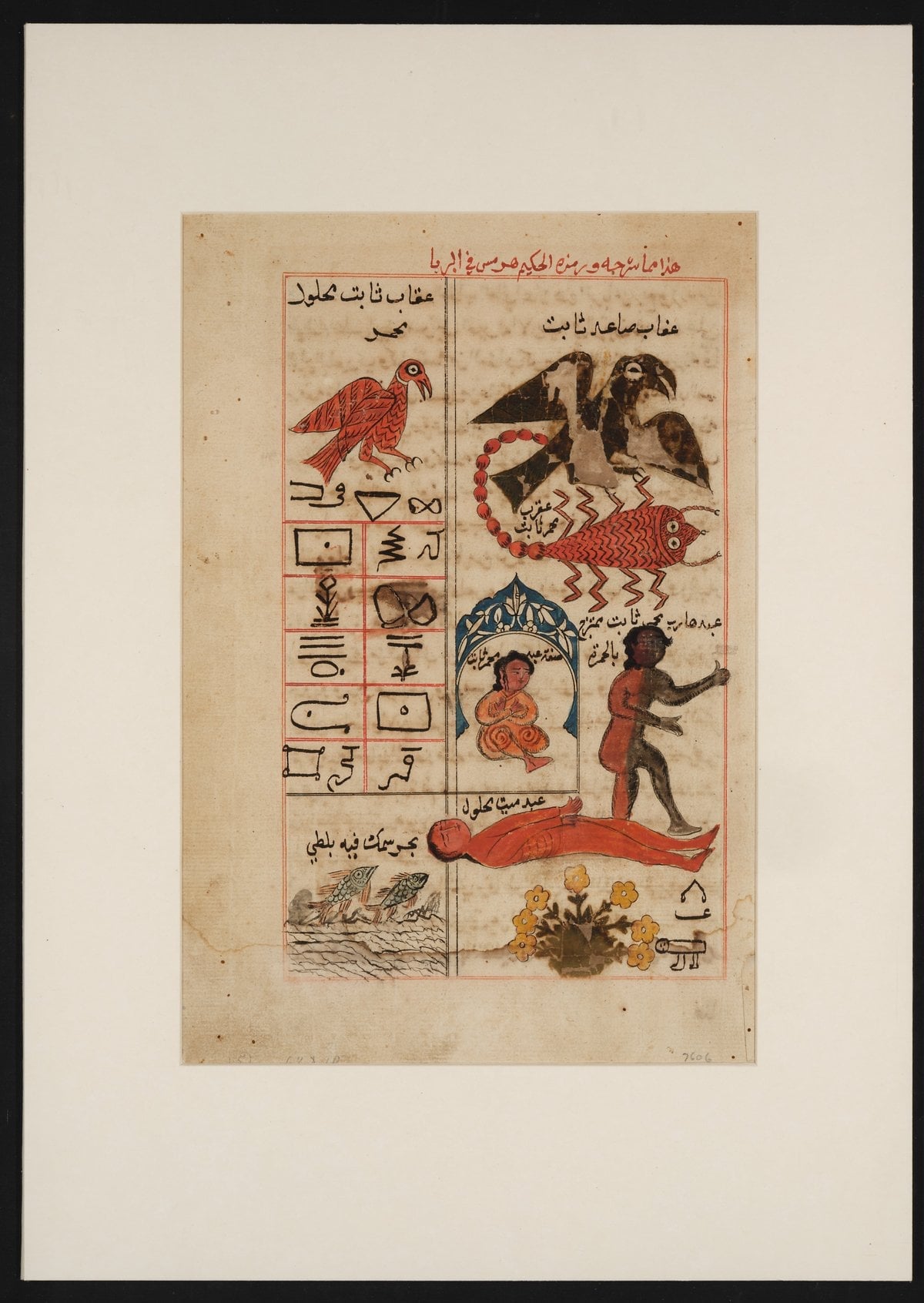
Islamic Alchemical Fragment — Arabic MS, 18th C.
Unknown
Paracelsus in Arabic — Kīmiyā al-Malakīyah (Royal Chemistry)
Paracelsus; Salih ibn Nasrallah ibn Sallum