Nova Reperta
A Renaissance visual manifesto of progress.
Illustrations
Browse all500 images extracted
This landmark illustration from Galileo Galilei's 1610 treatise 'Sidereus Nuncius' depicts the Moon as seen through his newly improved telescope. By showing a rugged, cratered surface instead of a smooth, perfect sphere, Galileo fundamentally challenged long-held Aristotelian beliefs about the nature of the heavens.
This intricate woodcut is the printer's mark of Tommaso Baglioni, appearing on the title page of Galileo Galilei's 'Sidereus Nuncius' (1610). It depicts an allegorical female figure, possibly representing Venice or Wisdom, seated before a coastal cityscape with a ship, symbolizing the maritime and intellectual prominence of the Venetian Republic. The presence of this elaborate emblem on such a revolutionary scientific work highlights the intersection of art, commerce, and the dawn of modern astronomy.
This illustration features the Papyrus nilotica, famously used in antiquity to create writing material. The woodcut captures the plant's tall, leafless stems topped by feathery umbels, depicted growing in a stylized marshy environment.
This woodcut illustrates the concept of 'Chorography' by drawing a parallel between the mapping of specific regions and the human senses of sight and hearing. The image juxtaposes a detailed landscape with a human eye and ear, suggesting that the study of geography is fundamentally rooted in sensory observation. This reflects early modern efforts to categorize knowledge through visual analogies between the human body and the natural world.
This woodcut diagram illustrates an experiment on magnetic repulsion and attraction. A hand holds two iron wires suspended by silk threads over a spherical loadstone, demonstrating how the magnetic 'sphere of influence' affects the orientation of the wires. This image is characteristic of early modern scientific treatises that sought to visualize physical phenomena through empirical observation.
This woodcut depicts a blacksmith hammering a bar of iron while it is aligned along a north-south axis, a method described by William Gilbert for inducing magnetism in iron. The scene is labeled with 'SEPTENTRIO' (North) and 'AVSTER' (South) to indicate the necessary orientation for the experiment. This illustration is from Gilbert's landmark 1600 treatise, 'De Magnete', which was the first major scientific work based on experimental evidence and established the Earth itself as a giant magnet.

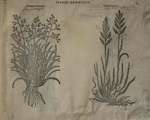
This large woodcut illustrates Chamaepytis, or ground-pine. The artist has carefully rendered the complex branching structure and needle-like leaves, providing a clear visual reference for the accompanying botanical description.

This intricate woodcut volvelle is a paper instrument used for astronomical and geographical calculations. It features a central landscape medallion and a movable pointer depicting a human figure, likely representing an observer. Such interactive diagrams were cutting-edge educational tools in 16th-century cosmographical treatises, allowing readers to physically manipulate the components to understand celestial mechanics.

This woodcut depicts the famous printer's mark of Christophe Plantin, featuring a hand emerging from a cloud to hold a pair of compasses. The accompanying motto, 'Constantia et Labore' (By Constancy and Labor), encapsulates Plantin's professional ethos: the fixed leg of the compass symbolizes constancy, while the rotating leg represents labor. As one of the most recognizable emblems in the history of printing, it signifies the scholarly excellence and industriousness of the Plantin Press in 16th-century Antwerp.
Visual Art
Browse all art →39 works of visual art in this collection
 print
printTrommelrohr", "Schlangenrohr
Athanasius Kircher
Two acoustic instruments, a membrane-amplified 'drum-tube' (Trommelrohr) and a winding 'serpent-tube' (Schlangenrohr), depicted as technical diagrams.
 print
printIllustration from “Pantometrum Kircherianum”, Max Planck Institute for the History of Science Library 03
Athanasius Kircher
An engraving of a man seen from behind supporting the 'Pantometrum,' a complex surveying and geometric measurement instrument designed by Athanasius Kircher.
 print
printInstrument (Walze) für die Herstellung eines ovalen Hohlraumes
Athanasius Kircher
A technical diagram of a mechanical instrument used for generating or modeling an oval shape.
 print
printOrganum Mathematicum Music Sample Columns
Athanasius Kircher
Two vertical rods or slats from Athanasius Kircher's Organum Mathematicum, used for the mechanical composition of music.
 print
printTitle page of “Pantometrum Kircherianum”, Max Planck Institute for the History of Science Library 01
Athanasius Kircher
The typographic title page of 'Pantometrum Kircherianum', a 1660 treatise detailing a universal geometric measuring instrument.
 print
printMap of Holland
C. D. H
This is a 16th-century cartographic print depicting the County of Holland, featuring the regional coastline, inland waterways, and major cities, embellished with a large central cartouche, nautical vessels, and a compass rose.
 print
printGeneral Chart by Adriaen Gerritsen van Haerlem
Haerlem, Adriaen Gerritsen van, -ca.1580
This is a detailed nautical chart (pascaerte) of the Atlantic coastline and European waters, featuring rhumb lines, compass roses, and heraldic shields belonging to various European powers and cities.
 print
printJohannes Zurenus
Hendrick Goltzius
A portrait of Jan van Zuren, a Haarlem burgomaster and printer, depicted at the age of seventy-one.
 print
printSoldier with Arquebus
Hendrick Goltzius
A Dutch musketeer in elaborate Mannerist military costume carrying an arquebus and a forked gun-rest.
 genre-scene
Exercities met een kanon: afvuren van een kanon
Jacques Callot
Two 17th-century soldiers performing a military drill, specifically the ignition and firing of a large cannon.
 genre-scene
Exercities met een kanon: richten van een kanon
Jacques Callot
A group of 17th-century artillerymen are depicted during a military exercise, focusing on the careful aiming of a large cannon.
 scientific
Exercities met een musket: afvuren van een musket
Jacques Callot
A sequence of three musketeers demonstrating the steps of loading, aiming, and firing a musket using a forked rest.
 genre-scene
Exercities met een musket: voorbereidingen voor het afvuren van een musket
Jacques Callot
Three musketeers demonstrating sequential steps for handling and firing a musket using a forked rest.
 print
printMap of Terra do Natal and East Africa
Langren, Arnoldus F. ab
This is a detailed 16th-century navigational chart of the southeast African coastline, the island of Madagascar (labeled S. Lorenzo), and the Indian Ocean, depicting maritime routes, reefs, islands, and coastlines including Mozambique and the Comoros.
 print
printMap of China, Indochina and Southeast Asia, 1595
Langren, Arnoldus F. ab
This is a 16th-century nautical chart depicting the coastal regions of Southeast Asia and East Asia, including China, Cambodia, Thailand (Siam), the Malay Peninsula, and Myanmar (Arracan and Pegu), populated with European-style sailing ships, sea monsters, and decorative compass roses.
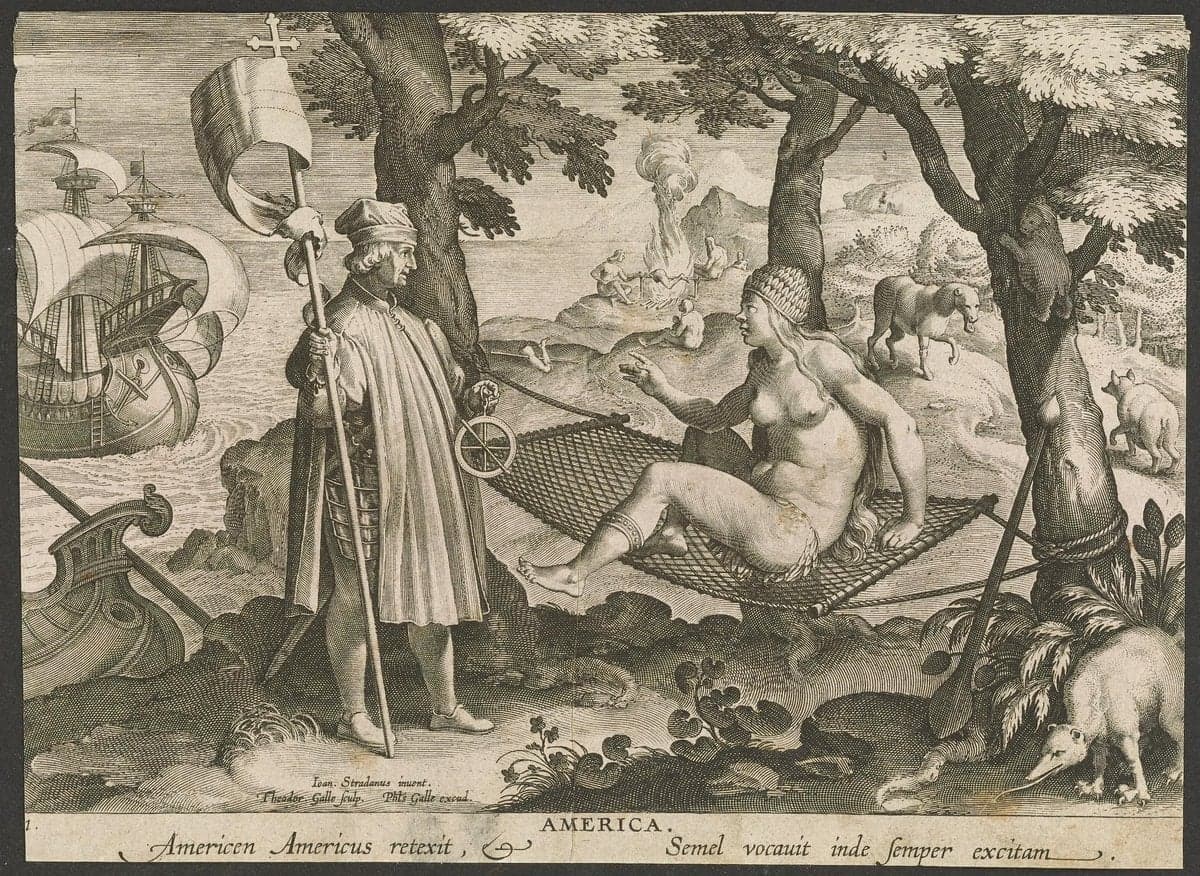
Around 1590, the Flemish artist Johannes Stradanus engraved 38 plates depicting "new inventions" — the printing press, gunpowder, the compass, the discovery of America, distillation, spectacles, the stirrup, the clock, the windmill. Each plate argued that the moderns had surpassed the ancients. This collection gathers the texts and images of the first age of progress.
Essential Reading
The foundational texts of this tradition

The Starry Messenger
Galileo Galilei, 1610
This groundbreaking work, enabled by the new invention of the telescope, provides empirical evidence of modern scientific superiority over ancient cosmology.
Historia navigationis in Brasiliam, quæ et America dicitur. Qua describitur autoris navigatio, quaeque in mari vidit memoriae prodenda : Villagagnonis in America gesta : Brasiliensium victus et mores, a nostris admodum alieni, cum eorum linguae dialogo : animalia etiam, arbores, atque herbae, reliquaque singularia et nobis penitus incognita. A Joanne Lerio Burgundo gallice scripta. Nunc vero primum latinitate donata, et variis figuris illustrata.
Léry, Jean de, 1586
A contemporary account of exploration to the Americas, directly illustrating the "discovery of America" as a key "new invention" of the age.
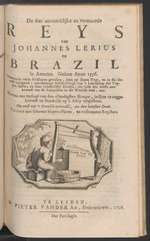
De seer aanmerklijke en vermaarde reys van Johannes Lerius na Brazil in America. Gedaan anno 1556. : ...
Lery, Jean de, 1706First from Dutch
Another significant account by Jean de Léry detailing voyages to the Americas, reinforcing the theme of modern geographical discovery.
Gedenkwaardige scheeps-togten na Rio de la Plata, in 't Zuyderdeel van America, en verscheydene andere vo...
Schmidt, Ulrich, ca1510-ca1579, 1706First from Dutch
This work documents early voyages to the Americas, exemplifying the era's advancements in navigation and global exploration.
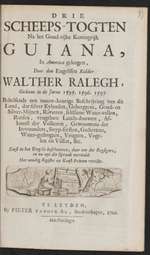
Drie scheeps-togten na het goud-rijke koningrijk Guiana, in America geleegen, door den Engelssen ridder Wal...
Hakluyt, Richard, 1706
Part of a foundational collection of voyages, this text highlights the extensive exploration of the Americas and the expansion of modern geographical knowledge.
Important Works
Significant texts that deepen understanding
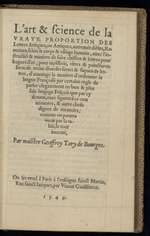
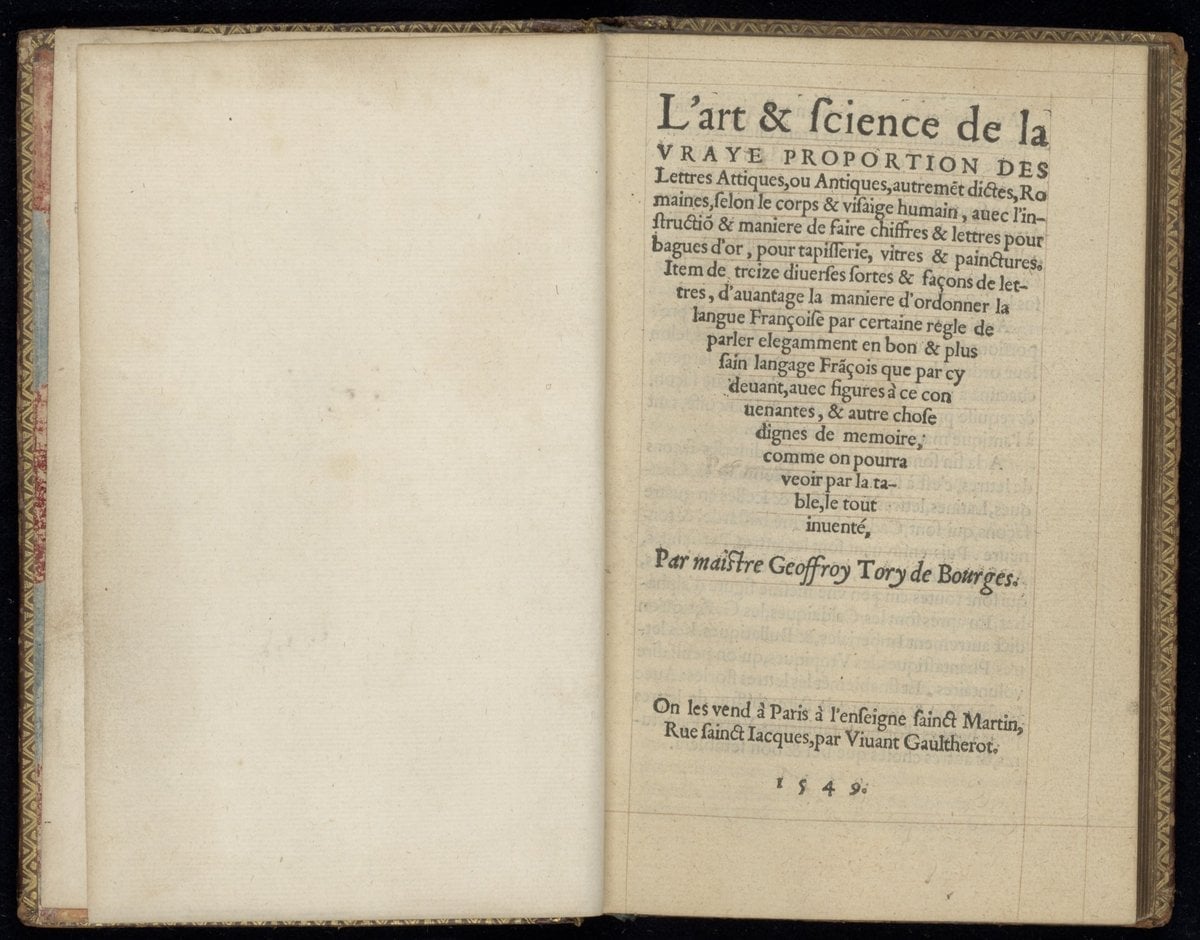
The Art and Science of the True Proportion of Attic Letters
Tory, Geoffroy, 1549
This work exemplifies Renaissance innovation in typography and design, a direct application and advancement of the printing press, one of Stradanus's "new inventions."
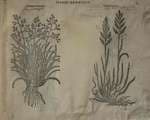
Icons of Plants
Matthias de Lobel; pub. Christophe Plantin, 1581First Translation
This botanical work, published by a leading printer, showcases advancements in natural history, scientific illustration, and the dissemination of knowledge through the printing press.
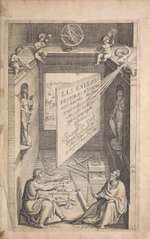
The Reasons of Motive Forces
Salomon de Caus, 1615First Translation
This treatise on mechanical principles and engineering directly relates to the development of new technologies and the understanding of physical forces in the age of progress.
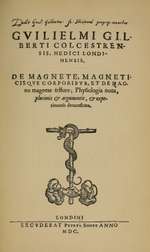
On the Loadstone and Magnetic Bodies (English Translation)
William Gilbert, 1893
Gilbert's original 1600 work was a landmark in experimental science, providing a modern understanding of magnetism directly relevant to the compass, a key "new invention."
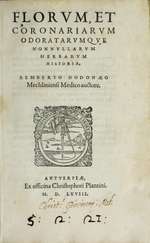
Florum et coronariarum historia
Rembert Dodoens, 1568First Complete Translation
A significant botanical text that demonstrates the era's progress in systematic observation and classification of the natural world, often facilitated by new printing techniques.
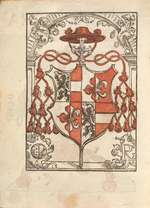
Cosmographic Book (Cosmographicus Liber)
Peter Apian, 1524
This work on cosmography and cartography reflects the profound advancements in understanding and mapping the world, directly linked to navigation and exploration.
Pal.lat.1375
Regiomontanus, Peuerbach, Hermes Trismegistus, et al., 1480First Translation
Contains works by leading Renaissance astronomers and mathematicians, representing significant intellectual progress in fields crucial to navigation and scientific understanding.
The Metamorphosis
Paracelsus, Theophrastus, 1584First Translation
Paracelsus's revolutionary approach to medicine and chemistry challenged ancient authorities, embodying the collection's theme of moderns surpassing the ancients.
On the Nature of Plants
Jean Ruel (Ruellius), 1543First Translation
An important early botanical text that illustrates the Renaissance's renewed focus on empirical observation and detailed description of the natural world.